
• Learn Italian

    How to Study Italian in 2026: A Sustainable Method

    Reading Time: 7 minutes

    If you are wondering how to study Italian in 2026 without burning out or giving up, this guide is for you.

    Every year, the same thing happens. Learners of Italian around the world start off with great enthusiasm, diving into a full immersion of apps, videos, textbooks, podcasts and grammar guides, often without a clear learning path.

    This initial phase of binge learning creates a powerful but deceptive feeling of progress. For a short time, everything seems to work. Then life gets in the way: lessons are skipped, words are forgotten, speaking still feels difficult, motivation slowly fades, and everything becomes a struggle. If this sounds familiar, keep reading!

    At the same time, more and more AI-based language learning apps promise quick results and effortless fluency. The concept is always the same: learn Italian quicklyspeak in weeksno effort required. This message is literally everywhere. Quick. Easy. Effortless.

    Seriously? No effort required?
    Learning a language is not effortless, and that’s exactly WHY it works.

    The truth is that improving your Italian does not depend on quantity only and is not effortless. It is based on something much simpler and much harder to maintain: consistency. Learning Italian (or any other language, for that matter) is not about finding the next tool, app or shortcut. It’s about choosing a study method that you can sustain over time.

    My take on how to study Italian in 2026

    In this article, I explain what it really means to study Italian in 2026, why fragmented learning rarely works, what research on language learning tells us, and how listening and speaking can become the centre of a realistic and effective routine.

    As I mentioned above, we should first and foremost get rid of the word “effortless.” Learning a language is never effortless, and it doesn’t need to be.

    Why do I keep saying in 2026?

    It’s very tempting for learners to jump from one book to another, from a video to a film or a deck of flashcards. While this may work for some of the most dedicated students, the result is usually frustration and a sense of dispersion.

    Since the advent of AI, the temptation to give in to a magical app or a magical prompt has complicated the picture, and in 2026 the risk will increase. The great promise of AI is to make everything easy for us, and that soon we will no longer need to put in any effort at all. But do we really want to give up that small but essential part of self-respect that pushes us to try, test our abilities, stay engaged with something meaningful? I hope not. Real progress comes from engagement, not shortcuts. And engagement is exactly what makes learning lasting. Clearly, any tool for learning languages is useful in itself; it’s how we use it that matters.

    How to study Italian effectively: less fragmentation, more continuity

    To reach our goal in Italian in 2026 let’s make a clear commitment: less fragmentation, more continuity. In Italian, we call this costanza, consistency, tenacity. Costanza means showing up again and again, even when progress feels slow.

    Prenditi tempo! Take your time. The hard truth is: learning Italian takes time.

    There are no magic formulas, but there is an effective way to avoid quitting along the way: studying in a consistent and sustainable way. In Italian: studiare con costanza, not occasionally, not only when motivation is high, but especially when things require some effort.

    Why studying Italian feels difficult (and why it’s not your fault)

    Many learners believe they are either good or bad at languages; but in reality, your natural ability is rarely the issue. The most common difficulties are:

    • fragmented study habits;
    • unrealistic expectations at the beginning;
    • intensive study periods followed by long breaks;
    • little actual practice – pratica reale – of the language.

    The result is often the same: progress for a while, then nothing. And every long break makes restarting harder.

    That’s why the key issue is not how much you study, but how often you return to the language. In Italian, this idea is simple: continuare. How to study Italian effectively? By keeping at it.

    What research says about language learning

    Research in cognitive psychology offers clear insights into how learning actually works. Our brain learns better through spaced practice and active recall rather than intensive study sessions and passive repetition (Dunlosky et al., 2013).

    In practical terms, this means that learning is more effective when:

    • you return frequently to the same content (ritornare sugli stessi contenuti);
    • you actively try to recall (recupero attivo);
    • you use the language out loud (parlare ad alta voce);
    • you leave time between study sessions (studio distribuito nel tempo).

    This approach favours consistent practice, pratica costante, not short-term performance.

    Consistency does not mean studying less

    This is an important point: costanza non significa studiare meno. It means studying in a sustainable way, at a pace you can maintain over time without burnout or frustration. In Italian: studiare in modo sostenibile. Here’s what an effective routine looks like:

    • it does not have to be extreme;
    • it does not have to be perfect;
    • it must be repeatable over time – ripetibile nel tempo.

    Regular study, even with variations in intensity, works better than occasional intense sessions that are impossible to maintain. If only I had known that back in my university days!

    Why listening and speaking are central

    Many students focus mainly on reading and writing exercises. These activities are useful, but they are not sufficient. A language is first of all suono, ritmo, movimento della bocca. If you do not listen (ascoltare) often and do not try to speak (parlare), the language remains an abstract concept.

    This is why listening and speaking are central to our method.
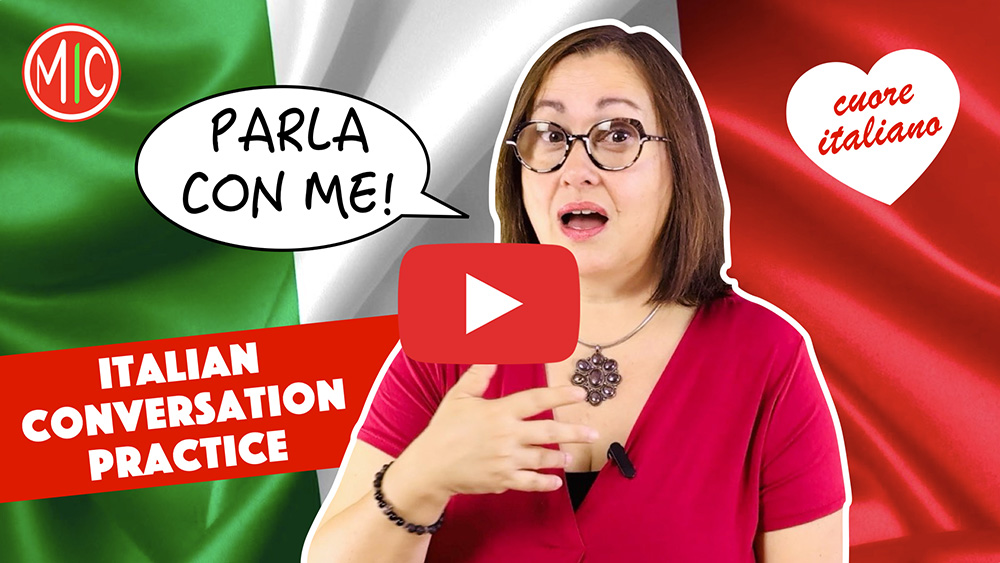
    In our Ascolta e Parla videos, the goal is not to understand everything. The real goal is to train:

    • your ear (orecchio);
    • your pronunciation (pronuncia);
    • your rhythm (ritmo);
    • your confidence (sicurezza) when speaking.

    Full understanding comes later; first comes the active use of the language, l’uso attivo della lingua, even with mistakes.

    How to use audio and video content effectively

    Watching a video passively is not enough: to study effectively, content must be reused. A productive approach includes:

    1. a first listen for general meaning (ascolto generale);
    2. a second listen and repeating aloud (ripetizione ad alta voce);
    3. an active recall phase: answering questions using the same words (recupero attivo);
    4. returning to the same content after a few days (ritornare dopo qualche giorno).

    Parla con me!

    This is the reason why in our videos I always encourage you to speak up, to respond, even with a yes or no or a few simple words. Passively watching a video is already something, but participating and being active gives us much more: it gives us confidence.

    An active approach is a real game-changer. Sometimes I ask for an immediate, intuitive response; other times I prompt for an answer on content, or ask learners to answer questions using the vocabulary presented in the lesson. All of this is repeated several times; additionally, committed learners have the opportunity to practise even more with the special content we prepare for our patrons on Patreon.

    Ama la tua voce italiana!

    Responding aloud makes all the difference. This way, we train our mouth to form sounds, familiarise ourselves with the melody and rhythm of sentences, and practise pronunciation. The next time we want to say something in Italian in real life, it will be much easier, because we have already done it.

    Consistency and repetition are essential. It is not wise to use study material only once, whether it is an article, an exercise, or a video. Watch a video over and over again until your answers come naturally. This way you will assimilate words, phrases, collocations, sounds; in short, you will develop a feel for the language.

    Common mistakes when studying Italian

    Many learners slow down or get stuck not because they lack ability, but because they fall into very common patterns: they keep looking up new ways to study Italian effectively and change methods too often, study only when motivation is high, avoid speaking for fear of making mistakes, and aim for perfection far too early. Making mistakes is not failure. Speaking imperfectly is simply part of the learning process.
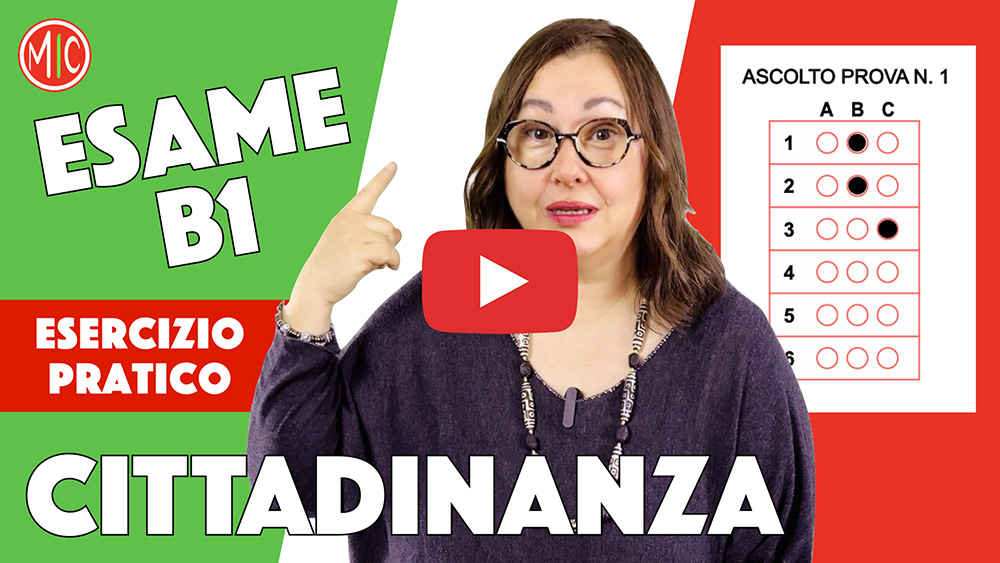
    Esame B1 Cittadinanza - B1 Italian Citizenship Certification

    On our YouTube channel, we talk a great deal about the B1 citizenship certification: during the oral exam, perfection is NOT a requirement, but clear communication is. The simple principle of keeping the main objective clear, i.e. communication, helps us to get started and get into the right gear. So, should we lower our ultimate goal and not worry about improving and correcting our mistakes? Should we abandon the desire to speak correctly? Absolutely not. But the fear of making mistakes shouldn’t stop us from opening our mouths and speaking Italian. And this is a major obstacle for many learners.

    Il tuo obiettivo per il 2026

    In 2026, the goal is not to study an enormous amount of grammar or vocabulary, to finish every textbook, to understand everything immediately, or to speak perfect sentences from the start. The real goal is continuare: to keep listening, to keep speaking, and to keep returning to Italian. Because what you practise with costanza, over time, truly becomes yours. This year, learn Italian consistently!

    In short: your 2026 routine should include regular and sustainable study, frequent listening, active use of the language, repeated exposure to the same material, and acceptance of imperfection. Create a path that you can realistically maintain over time.

    Visit our main website to find all our video lessons and additional learning materials listed by topic and level, and get in touch if you need advice on your specific situation: I will be happy to help.

    Buono studio!

    Anna

    Italian Lessons for Beginners

    Italian Textbooks

    (Amazon affiliate links)
  • Learn Italian

    Certificazione B1 Cittadinanza: cos’è e come è fatto l’esame

    Reading Time: 4 minutes

    L’esame B1 Cittadinanza è l’esame necessario per ottenere la cittadinanza italiana. Chi deve farlo? Quali sono le prove dell’esame e come bisogna prepararsi? Oggi risponderò a tutte queste domande.

    1. La cittadinanza italiana: residenza, matrimonio, discendenza

    La certificazione linguistica di livello B1 Cittadinanza è quella richiesta per ottenere la cittadinanza italiana per residenza o matrimonio: oltre a tutti i documenti che devi presentare, devi anche fare un esame per dimostrare che conosci abbastanza bene l’italiano.

  • Italian Grammar

    Gli articoli determinativi: How to Use Definite Articles in Italian

    Reading Time: 4 minutes

    L’amore. Gli spaghetti. La nonna. Il vino. L’Italia. What are the little words you see before all these nouns? They all mean the; they are all definite articles. What are they and why so many different ones? How to use definite articles in Italian? In this article I will answer these questions and I will help you make sense of this tricky feature of the Italian language.

    What are definite articles?

    Basic rule, which applies to many different languages, including English: definite articles are used to refer to a specific thing or person. So:

    THE house you see is mine. = LA casa che vedi è mia.

    THE black dog is mine. = IL cane nero è mio.

  • Cultura e società - Varie

    Il passaporto italiano: un sogno infranto?

    Reading Time: 3 minutes
    Nuova legge cittadinanza italiana

    Che cos’è un sogno infranto? È un sogno che non si può realizzare. E questa è la dura realtà per molti cittadini stranieri di origine italiana, che hanno sperato per lungo tempo di ottenere la cittadinanza del Bel Paese. (Se ti stai domandando quale sia il Bel Paese, te lo dico io: è l’Italia!) La nuova legge sulla cittadinanza italiana per molti è una nuova, dura realtà.

    Un viaggio attraverso il tempo

    Con la vecchia legge, era sufficiente dimostrare di avere un antenato (una persona della tua famiglia vissuta molto tempo fa) italiano per chiedere la cittadinanza italiana. Questo antenato doveva essere nato in Italia dopo il 17 marzo 1861. Per noi italiani questa data è molto importante: è il giorno in cui Vittorio Emanuele II di Savoia, Re di Sardegna e Piemonte, uno dei principali promotori del movimento indipendentista italiano, diventò il primo Re d’Italia. (un re è una persona che governa un paese per diritto di famiglia, come Re Carlo d’Inghilterra). Questa legge era un filo che legava i discendenti degli italiani nel mondo a quel momento unico nel passato, quando l’Italia è diventata un paese unito e indipendente!

  • Luoghi d'Italia

    Qual è la piazza più grande (e più bella) d’Italia?

    Reading Time: 4 minutes

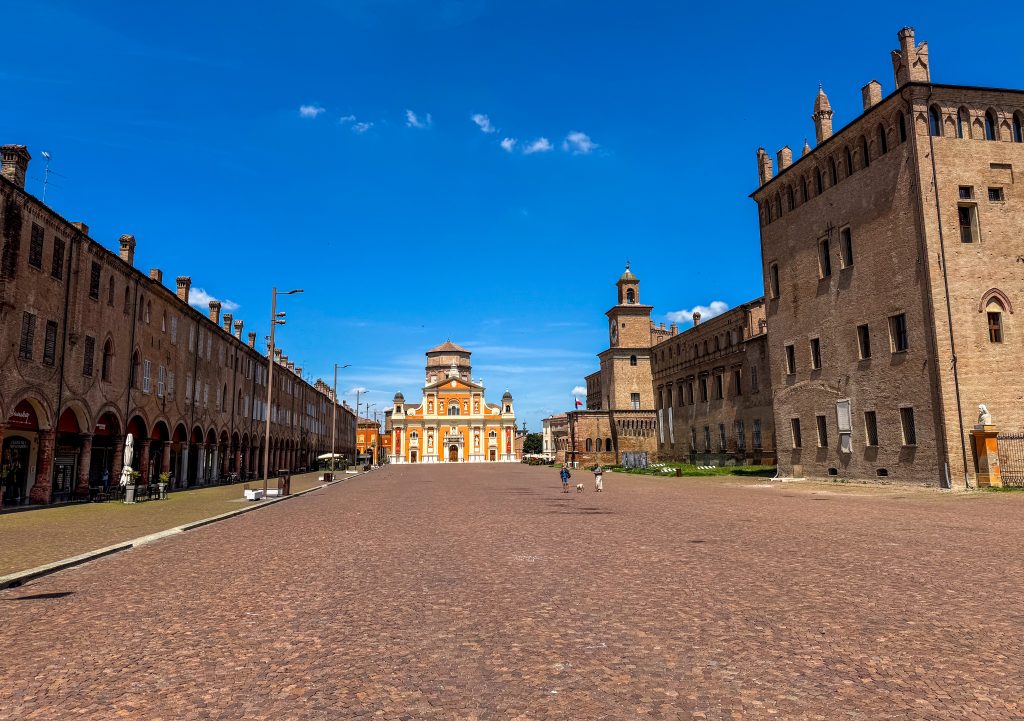
    Qual è la piazza più grande d’Italia? In quale città si trova? C’è piazza San Marco a Venezia, naturalmente; piazza Bra a Verona e piazza Duomo a Milano; a Roma ci sono piazze grandissime, e così a Napoli e a Torino; molte di queste però sono in realtà grandi incroci trafficati, oppure dei giardini.

    Cos’è la piazza per gli italiani

    In Italia la piazza è il luogo d’incontro per eccellenza, una di quelle cose che mancano tanto agli italiani che vivono all’estero, insieme al suono delle campane. La piazza è il luogo in cui lo sguardo spazia, l’orizzonte si apre, la città respira: deve essere pedonale, senza automobili strombazzanti e motorini rombanti, deve essere sgombra e aperta. Oggi voglio parlarvi di una cittadina poco nota che ospita una delle piazze più grandi e più belle d’Italia, una piazza come Dio comanda!

  • Italian Grammar

    How to Be Polite in Italian: the Present Conditional

    Reading Time: 4 minutes

    Vuoi fare bella figura? Usa il condizionale presente!

    What is a bella figura? It’s a good impression. Read this article if you want to learn how to be polite in Italian and make a bella figura.

    Your new friend: the present conditional

    The present conditional tense is extremely versatile: mastering its usage in Italian will enhance your communication skills and leave a positive impression. This tense is very common in everyday conversation, from chatting with friends to ordering your favourite meal at your go-to restaurant in Italy, so the use of the conditional is a practical skill that is never too early to acquire.

    When to use the present conditional

    We use the present conditional tense to:

    1. Express a wish: Un giorno vorrei visitare la Sicilia. I would like to visit Sicily one day.
    2. Make a polite request: Potresti passarmi il sale, per favore? Could you pass me the salt, please?
    3. Express a possibility or make a hypothesis: Sarebbe divertente partecipare a un corso di cucina insieme. It would be fun to take a cooking class together.
    4. Give advice: Secondo me dovresti leggere quel libro, è davvero interessante. In my opinion, you should read that book; it’s really interesting.
    5. Make a suggestion: Potremmo andare al cinema stasera. We could go to the movies tonight.

    Vorrei, potresti, sarebbe, dovresti, potremmo are all examples of present conditional.

    How to form the present conditional

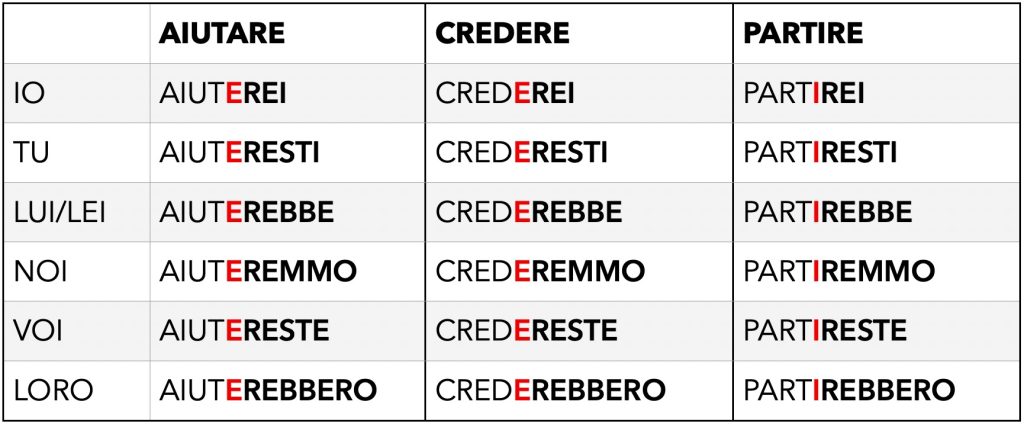
    The regular conjugation of the present conditional is quite simple: verbs in -ARE and verbs in -ERE follow the same pattern, while verbs in -IRE just change the -E- to -I-.

    How to form the present conditional in Italian: regular conjugation
    Condizionale presente – coniugazione regolare

    Two spelling rules to keep in mind for some verbs:

    • Verbs ending in -ciare and giare lose the I before the ending: Io mangerei qualcosa, ma non so cosa. I would eat something, but I don’t know what. Mangerei, not *mangierei.
    • Verbs ending in -care and -gare add an H before the ending to maintain the hard sound of c and g: Pagherei io il conto, ma ho lasciato il portafogli in macchina. I would pay the bill, but I left my wallet in the car. Pagherei, not *pagerei.

    The conditional of irregular verbs

    Many common verbs are irregular, but they share a common pattern.

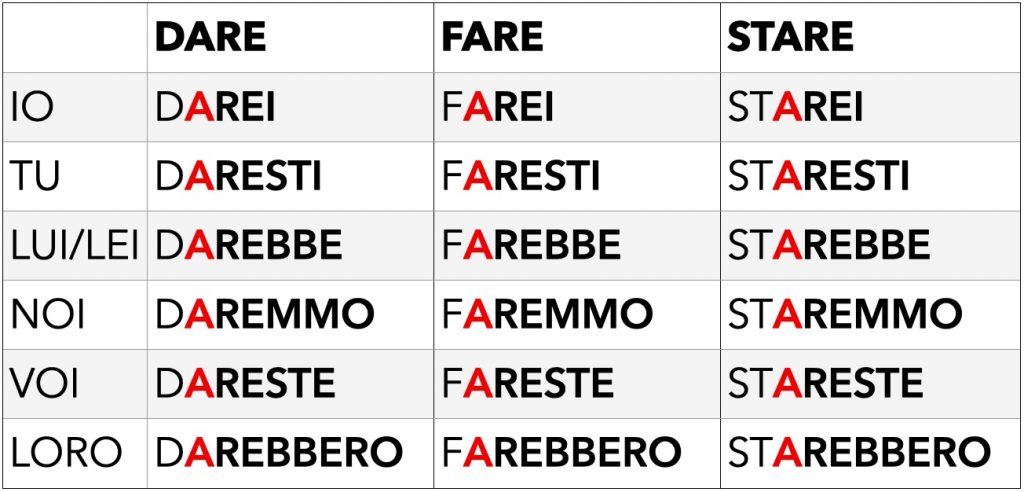
    Dare, fare and stare keep the A in their endings:

    How to form the present conditional in Italian: irregular verbs

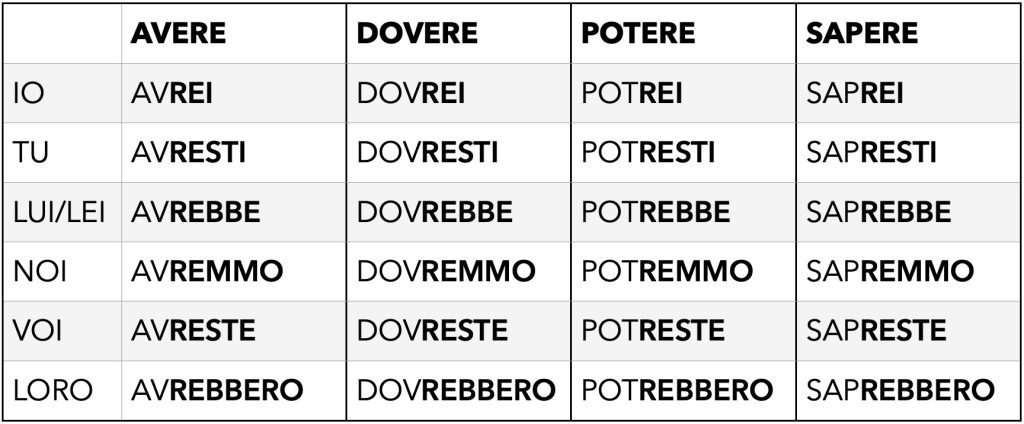
    Other verbs drop the first E of their endings: Avresti un po’ di farina? Do you have some flour? Avresti, not *averesti.

    These verbs include: andare, avere, dovere, potere, sapere, vedere, vivere:

    How to form the present conditional in Italian: irregular verbs
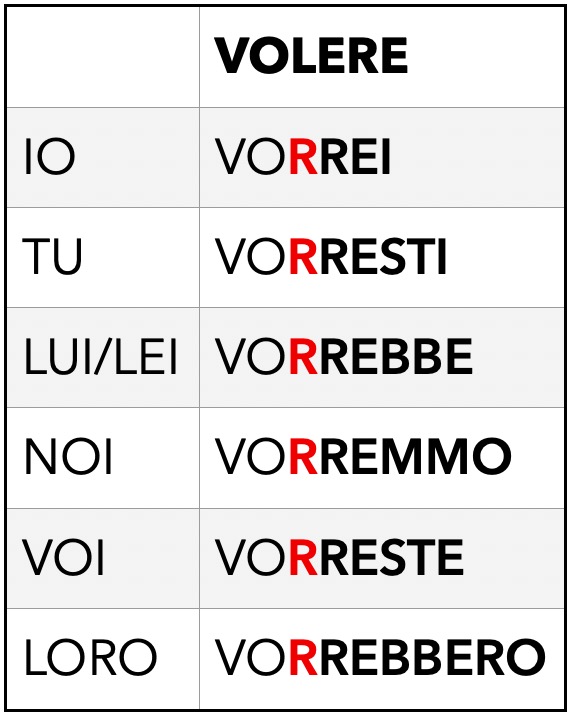
    How to form the present conditional in Italian: volere
    Volere – condizionale presente

    The verb volere changes its stem from VOL- to VOR-. Vorrei fare una torta. I’d like to bake a cake. Vorrei, not *volerei.

    Some other verbs behave like volere: they drop the E of the infinitive, and the last consonant of the verb stem changes to R: rimanere, tenere, venire. Verrei al cinema con te, ma quel film non mi piace. I would go to the cinema with you, but I don’t like that film. So it’s verrei, not *venirei; rimarrei, not *rimanerei; terrei, not *tenirei.

    Sarei e andrei

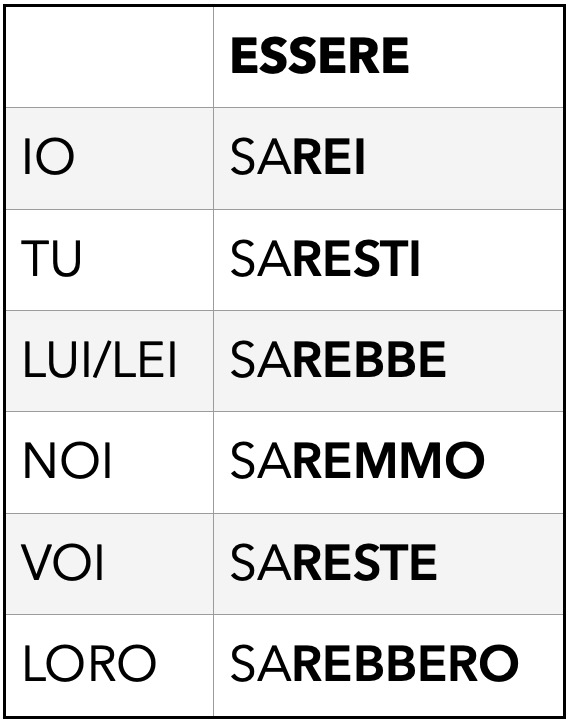
    How to form the present conditional in Italian: essere
    Essere – condizionale presente

    The verb to be, essere, is in many languages the most irregular of all. In the present conditional it has a completely different stem: we do not say *esserei but sarei, not *esseresti but saresti, and so on.

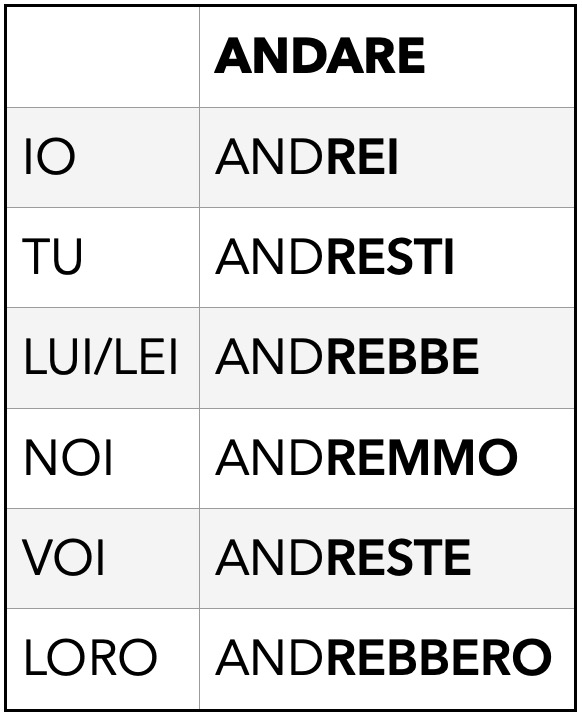
    How to form the present conditional in Italian: andare
    Andare – condizionale presente

    The same is true for the verb andare: while the present indicative alternates between the stem VAD and the stem AND, the present conditional is based solely on the stem AND:

    Let’s practise!

    E ora un piccolo esercizio! Completa le frasi con il condizionale presente. Complete the sentences with the present conditional and Write your answers in the comments!

    1. (Io, volere) _________ un caffè corretto, per favore.
    2. (Tu, venire) _________ a Milano con me la settimana prossima?
    3. (Loro, potere) _________ aiutarci, ma sono pigri.
    4. Al tuo posto, non (io, dare) _________ la mia auto a Paolo.

    Alla prossima,

    Anna

    Related content:

    • The Italian Present Conditional – VIDEO
    • The Italian Past Conditional – VIDEO

  • Luoghi d'Italia

    Non è la solita Toscana – Tuscany off the beaten track

    Reading Time: 3 minutes

    Carissimi! Sono tornata da una breve vacanza semplicemente ME-RA-VI-GLIO-SA, e ora che ho avuto tempo di riordinare le foto voglio parlarvene subito! Sono stata in Toscana, ma non nei soliti posti dove vanno sempre tutti. Lo so che la Toscana la conoscete, è una delle regioni più visitate d’Italia: ma scommetto che non siete mai stati, per esempio… a Radicondoli! Ecco, già il nome di questo paesello è fuori dall’ordinario. E pensate che se volete trasferirvi qui, il comune vi paga metà dell’affitto per tre anni. Sono poco più di 900 abitanti e vogliono diventare mille – è un bellissimo posto, pensateci!

  • Luoghi d'Italia

    Il borgo più bello d’Italia

    Reading Time: 2 minutes

    Una cittadina fortificata tra i vigneti del Veneto

    Carissimi, oggi voglio parlarvi di una località italiana che forse non conoscete, anche se – udite udite! – un paio d’anni fa è stata eletta addirittura “borgo più bello d’Italia”.

    Innanzitutto, cosa vuol dire borgo? Il borgo è un centro abitato, una cittadina, un paese, o anche un quartiere di una città: a Verona molti quartieri si chiamano borghi, ma questo ve lo racconterò un’altra volta. In latino però voleva dire castello fortificato, e in questo caso è proprio così: si tratta di una cittadina murata, cioè circondata da mura tutto intorno, con ben ventiquattro torri e un meraviglioso castello medievale che domina il paese, in cima alla collina.

  • Varie

    I miei propositi per il 2025 – My new Year’s Resolutions

    Reading Time: 2 minutes

    Carissimi, ben ritrovati in questo 2025 nuovo di zecca!

    Nei primi giorni del nuovo anno si parla sempre di desideri, obiettivi, propositi: ne parla anche Anna nel primo video del 2025. Potevo essere da meno? E allora ecco i miei propositi.

    Per prima cosa mi propongo di scrivere spesso su questo blog. Ho così tante idee… troppe! Dovrò mettere ordine e tirarle fuori una per una. Spero che verrete a leggerle.

    In secondo luogo vorrei visitare ogni tanto una città, un paesino o una località che non conoscevo o cui non ho mai prestato attenzione. Vorrei fuggire dai luoghi turistici, dalla folla, dalle persone intente solo a farsi dei selfie col telefonino invece di guardarsi intorno, di respirare l’atmosfera, di cogliere la bellezza che li circonda. Vorrei trovare degli scorci che non avevo mai notato prima. Un’angolino d’Italia solo per me, anzi tanti angolini. So che ci sono, e li troverò! Magari li condividerò con voi.

  • Varie

    Benvenuti sul nostro blog!

    Reading Time: < 1 minute

    Eccoci finalmente insieme sul nostro nuovo blog! Sono la vostra simpaticissima Genoveffa, protagonista di tante discussioni intelligenti e furbe con la nostra insegnante di italiano preferita, Anna di My Italian Circle.

    In queste pagine parlerò un po’ di tutto, di lingua italiana naturalmente, ma anche di cultura e società, abitudini e luoghi comuni, il tutto visto attraverso l’occhio acuto della vostra Genoveffa! Anna invece parlerà di grammatica… che noia!

    A prestissimo. Vi amo!

    Genoveffa