How to Wish a Merry Christmas in Italian
So… you are spending the holiday season in Italy, and your Italian friends have invited you over on Christmas Day. You are thrilled at the idea, but you are feeling a bit anxious because you can’t tell the difference between panettone and pandoro, and you are not sure how to wish a Merry Christmas to your friend’s parents in a polite way. Then there is the matter of New Year’s Eve, when a flood of good wishes is exchanged even with strangers, and lots of toasts are made. How to join the conversation?
Buon Natale e felice anno nuovo!
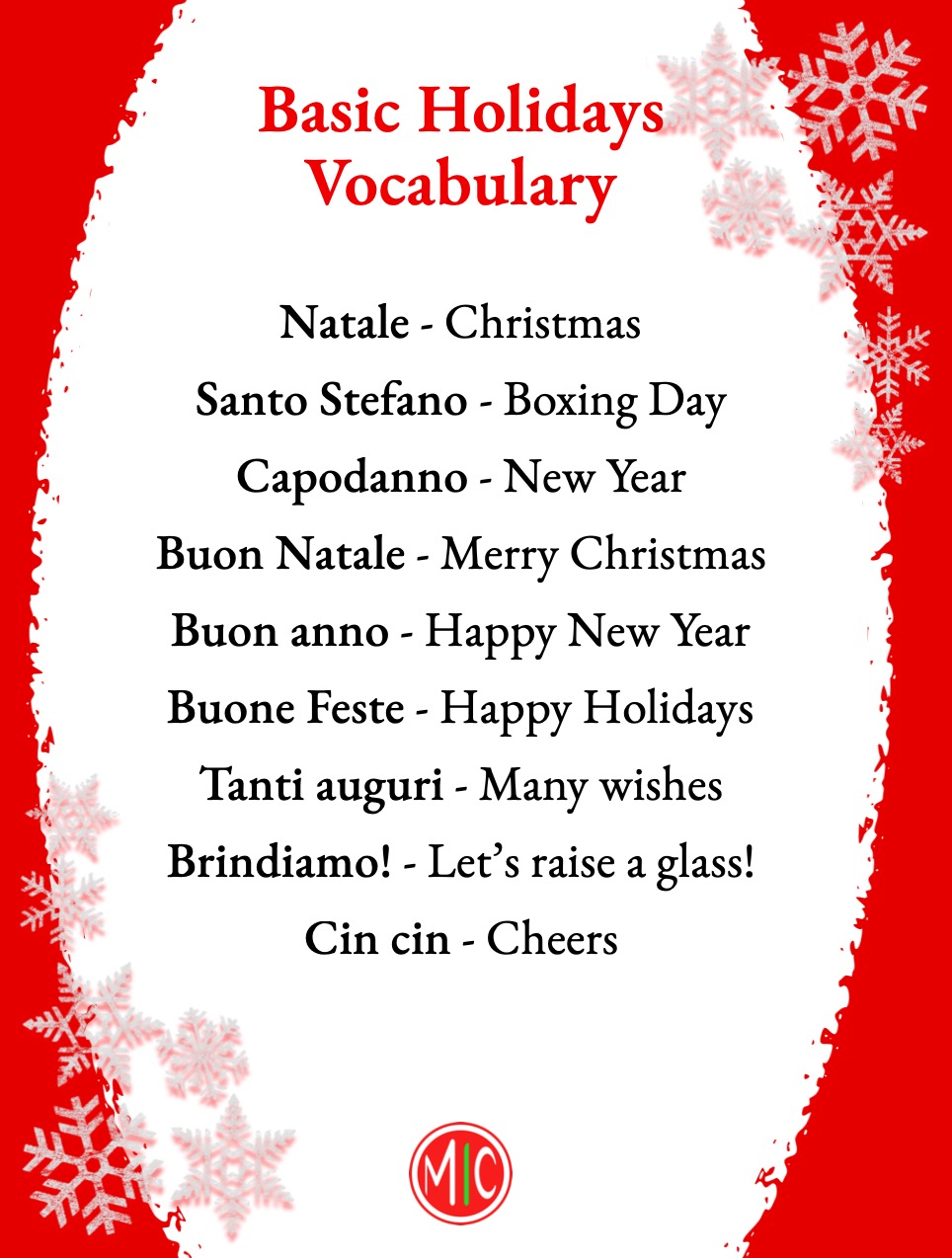
Let’s start with wishes – in Italian, auguri. This simple word can be used in various situations, including on a birthday or other anniversaries. Tanti auguri is a a step further: many wishes. If you want to overdo it, you can say Tantissimi auguri!
Most Italians are raised Catholic and celebrate Christmas with family, even those who do not go to church at all or only go on Easter and Christmas. Buon Natale (Merry Christmas) is a wish that anyone will welcome and return, but throughout the holiday season you can also use a more generic Buone Feste (happy holidays).
Here’s a nice wish for a friend and their family:
- Buone Feste a te e alla tua famiglia.
If you don’t know the person very well, use the polite form:
- Buone Feste a Lei e alla Sua famiglia.
Fast forward to New Year’s Eve: la vigilia di Capodanno. It is usually celebrated with a big dinner – il cenone – and lots of toasts – brindisi – as the clock strikes midnight. Then you can say:
- Buon anno! or Felice anno nuovo! – Happy New Year!
- Buona fine e buon inizio! – Happy endings and happy beginnings!
Tanti auguri works great here, too. Cin cin (cheers) is mandatory during a toast, to be said as you clink your glasses together and look at the other person in the eye. What to do if you don’t drink? Remember that toasting with water is considered bad luck, so you may want to fill your glass with wine anyway, just for show.
As an aside, do not believe those who claim that simple words like auguri, cin cin, grazie and prego should not be used. We say them all the time and they can go a long way! It’s great to have a large vocabulary at hand, but do not feel compelled to use long, convoluted sentences.

Il Natale in Italia
Some Italian families celebrate on Christmas Eve – la vigilia di Natale, while others have a big Christmas lunch – il pranzo di Natale, and some do both. Some go to Mass on Christmas Eve – la Messa di Natale, and may have a glass of wine and a slice of pandoro with fellow parishioners afterwards.
What do we eat on Christmas? Traditions vary widely throughout the peninsula, but Christmas lunch is usually very rich and features a lot of meat. Tortellini in brodo, lasagne or another kind of pasta are a staple, followed by lesso or bollito (boiled meat with various sauces), arrosto (roast), abbacchio (roast lamb), or cappone ripieno (stuffed capon). Not quite vegetarian friendly!
Pandoro o panettone?
After lunch, the dilemma is: pandoro o panettone? Or maybe another traditional Christmas cake? Pandoro hails from Verona, in Veneto, while panettone originated in Milan. Both are very popular all over Italy, with new fillings and variants created every year, but there are alternatives. In the South, a huge variety of traditional desserts is made, including struffoli, mostaccioli, cartellate, torrone and many others.
I regali di Natale – Christmas presents – are a big part of the celebration, and not just for children. They can be opened after dinner on Christmas Eve, on the morning of Christmas day or after lunch. They are brought by Babbo Natale (Santa Claus), of course, who puts them under each family’s Christmas tree – l’albero di Natale. L’albero e gli addobbi natalizi (Christmas decorations) are usually put up on December 8th, which is a public holiday: l’Immacolata Concezione di Maria. Many families also prepare a nativity scene, il presepe, with figurines of Giuseppe, Maria, il bue, l’asinello, le pecore e i pastori. Il Bambin Gesù, baby Jesus, is put in the manger at midnight on Christmas Eve. I Re Magi, the Three Wise Men, arrive on January 6th, il giorno dell’Epifania, when all festivities end: L’Epifania tutte le feste porta via.
A Christmas tradition that is fading away with the older generations is la tombola, a board game similar to bingo which originated in Naples three centuries ago. For some families, though, giocare a tombola is still a popular afternoon activity to spend more time together after lunch.
The day after Christmas is called Santo Stefano – Boxing Day. It’s also a public holiday in Italy, and may be spent visiting relatives, going to the mountains, or just chilling out.
Cosa fai a Capodanno?
As the new year approaches, the same question resounds everywhere: Cosa fai a Capodanno? What are you doing on New Year’s Eve? And the second most common question is Cosa ti metti? What will you wear? Whatever your answer may be, make sure to wear something red for good luck!
Most people will spend New Year’s Eve at dinners and parties, usually with friends. Festeggiamo la fine dell’anno e l’inizio dell’anno nuovo, we celebrate the end of the year and the beginning of the new one. Brindiamo all’anno nuovo, we raise a glass to the new year, e speriamo che sia migliore del precedente, and we hope it will be better than the last one. Around midnight we eat cotechino e lenticchie: pork sausage and lentils. The latter are said to bring money because they look like tiny coins.
Festeggiamo il Natale insieme
Let’s put all this together and celebrate Christmas the Italian way! Marta invites Janet to spend Christmas together. Their exchange may go like this:
Marta: Cosa fai a Natale? Vieni a pranzo da noi?
Janet: Molto volentieri, grazie.
On Christmas, Janet arrives at Marta’s house. She brings a bottle of wine, a foolproof gift.
Janet: Buon Natale! Ho portato una bottiglia di vino.
Marta: Che gentile! Vieni, ti presento mio marito e i miei genitori.
Janet: Piacere! Grazie dell’invito. Che bella casa!
Marta: Ti piacciono gli addobbi? Li ho presi ai mercatini di Natale.
Janet: Mi piacciono molto. Quest’albero di Natale è meraviglioso!
After a light aperitivo, the Christmas lunch begins with homemade tortellini.
Marta: Andiamo a tavola! È pronto.
Janet: Che bella tavola!
Marta: Ecco i tortellini. Li abbiamo fatti in casa.
Janet: Sono buonissimi, complimenti!
Marta: Ti piace il lesso con la mostarda?
Janet: Non l’ho mai mangiato, ma lo assaggio volentieri.
Marta: Preferisci il pandoro o il panettone?
Janet: Per me una fetta di pandoro, grazie.
Marta: Brindiamo! Buon Natale a tutti!
Janet: Cin cin! Tanti auguri!
Marta: E ora apriamo i regali di Natale. Questo è per te!
Janet: Grazie, non dovevi. È bellissimo!
Marta: È solo un pensierino. Giochiamo a tombola?
Janet: Certo!
We hope you will now feel ready for your Italian Christmas.
Auguriamo a voi e alle vostre famiglie Buone Feste e un felice Natale! We wish you and your loved ones Happy Holidays and a Merry Christmas.
Anna & Diana
Related videos:
- Racconti di Natale – Christmas Stories in Italian
- Buon Natale! Ascolta e rispondi – Italian Listening Practice
- Una storia di Natale – Italian Listening Practice