
[Leggi questo articolo in italiano]
Some museums display art; others allow you to feel as though you have stepped into the very space where art history took shape. The Uffizi Gallery belongs firmly to the second category: a place where the distance between present and past narrows so much that you begin to sense the Renaissance not as a historical period, but as a living presence unfolding around you.
The Uffizi Gallery sits right in the centre of Florence, between the river and Piazza della Signoria, yet the moment you step inside, the atmosphere changes. The noise of the city fades, replaced by the soft echo of footsteps on stone floors and the quiet movement of visitors adjusting to the light. The building seems to invite you to slow down, look carefully, and let the Renaissance reveal itself room by room.
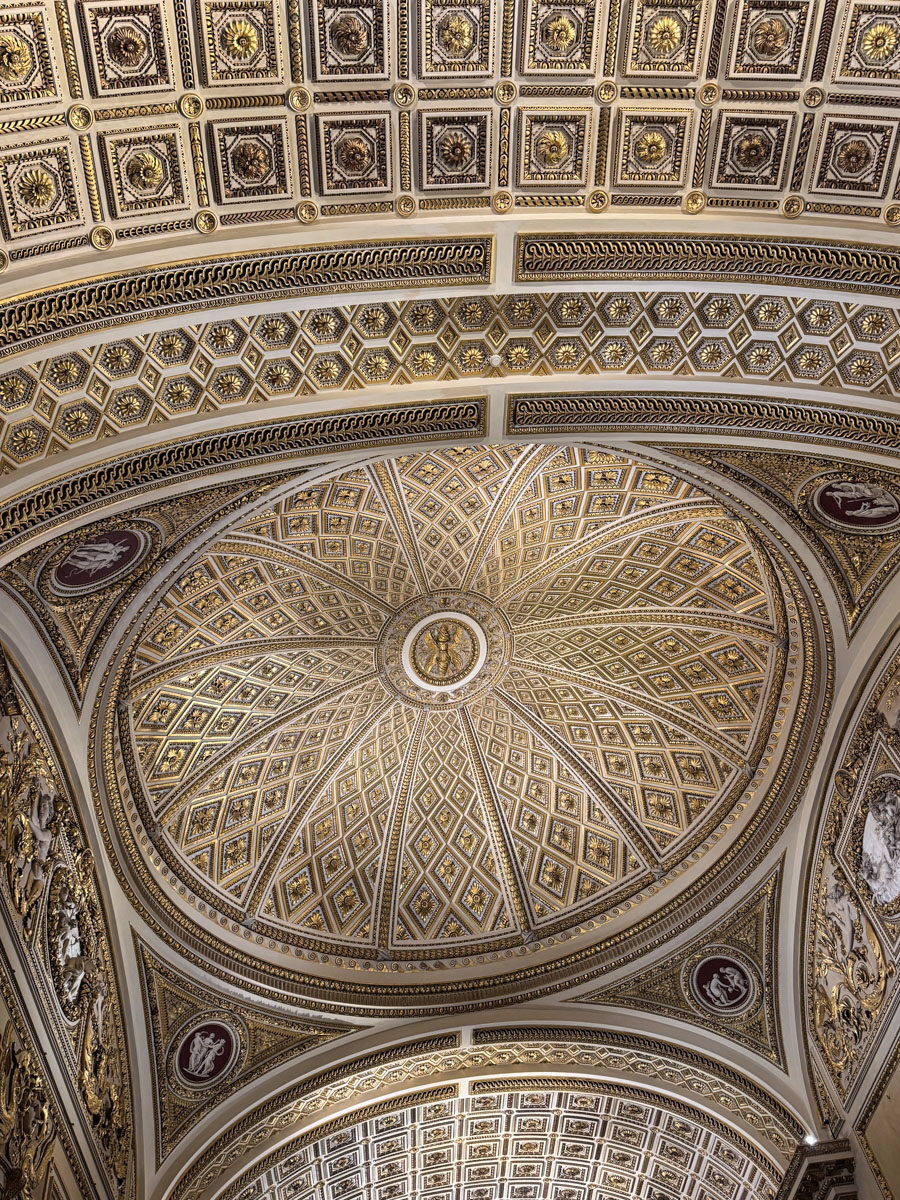
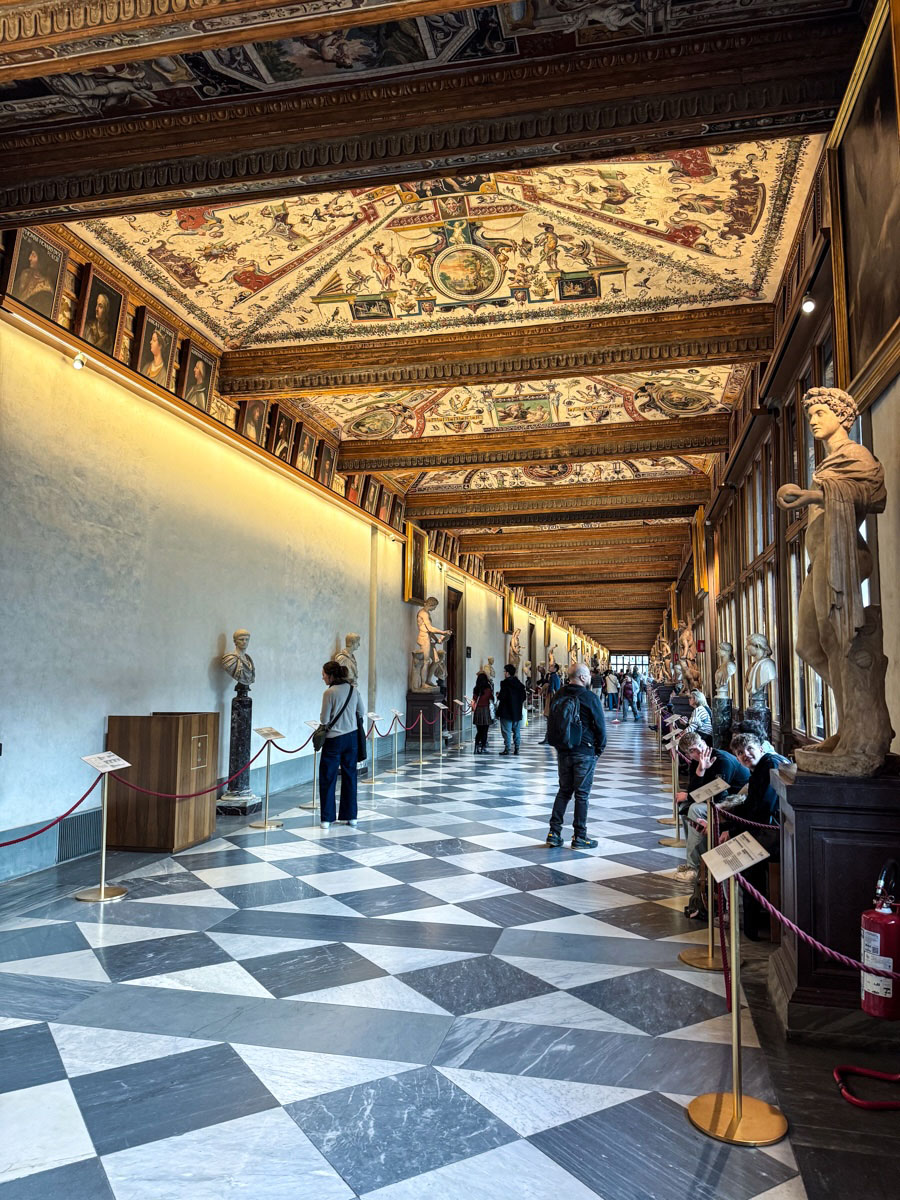
As you move through the entrance, the building itself guides your attention. The visit begins with a long walk up the staircase and into the corridors designed by Giorgio Vasari in the 16th century. The long sequence of vaulted ceilings and the rhythm of statues and portraits create an atmosphere that helps you prepare for the encounters ahead. Through the windows, Florence appears framed like a series of paintings: Ponte Vecchio, the rooftops, the dome of the cathedral in the distance. It’s a moment of transition, a gentle shift from the present into a different kind of time.
This is where the word rinascimento — “rebirth” — starts to feel appropriate. It’s not just a historical term; it describes the sense of curiosity and renewal that shaped the art you are about to see.
Cimabue, Giotto, and the First Steps Toward the Renaissance
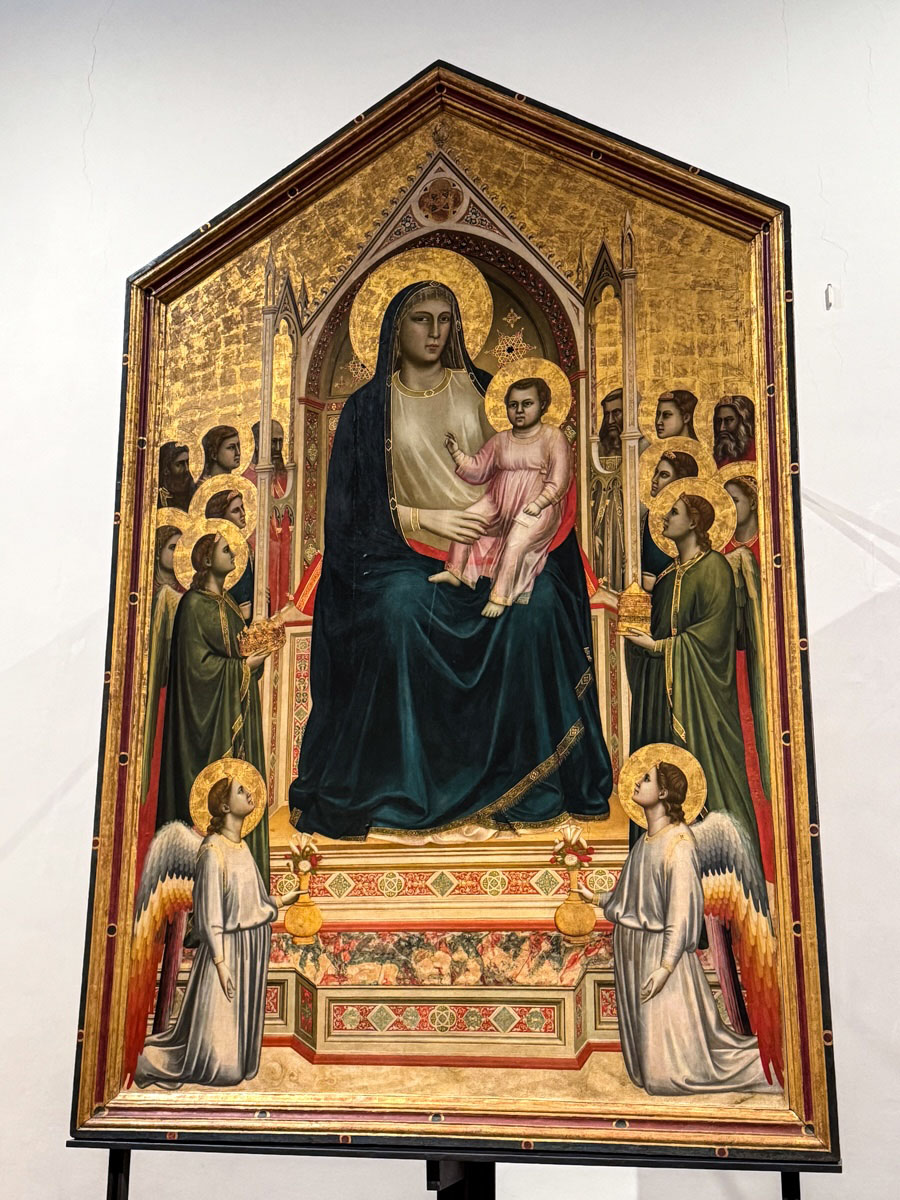
The Uffizi’s story begins before the Renaissance itself, in the rooms dedicated to the early masters. Here, works by Cimabue and Giotto show the moment Italian painting began to shift away from the rigid, symbolic language of Byzantine art toward something more human, spatial, and emotionally legible. Cimabue’s altarpieces still carry the solemn gold backgrounds and elongated figures of medieval tradition, yet you can sense an early curiosity for volume and presence. His Madonnas feel slightly more grounded, their gestures more intentional, as if the painter were testing how far he could push the boundaries of the sacred image without breaking them.
Giotto takes that tentative step and turns it into a confident stride. His works in the Uffizi reveal a painter who understood space not as a decorative surface but as a stage where human stories unfold. Faces gain weight and individuality, drapery falls with believable gravity, and gestures begin to express real emotion rather than symbolic convention. Standing before these panels, you can feel the Renaissance gathering momentum long before Botticelli or Leonardo appear.
Botticelli: Where Mythology and Light Converge
The transition into the Botticelli rooms is almost imperceptible, yet unmistakable. Standing before the Birth of Venus or Primavera, you realize how inadequate reproductions are: the paintings are larger, more delicate, and more complex than memory suggests. The figures appear suspended in a world where myth and nature coexist. Botticelli’s idea of bellezza — beauty as harmony and proportion — becomes clearer when you can stand close enough to see his fine brushwork.
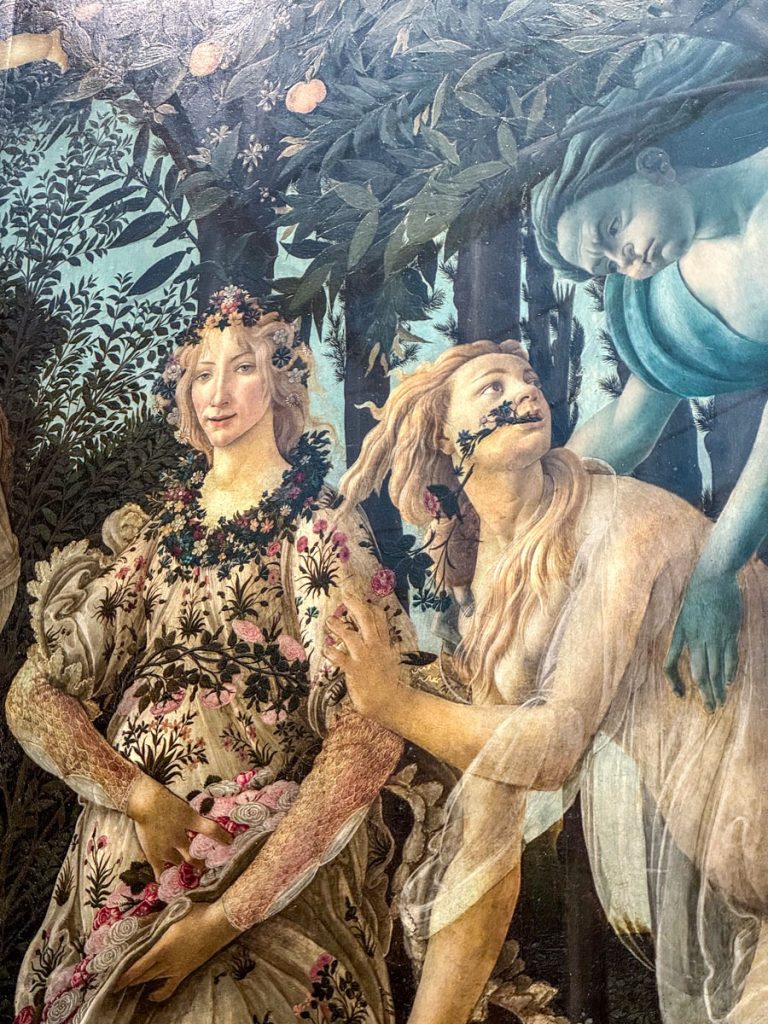
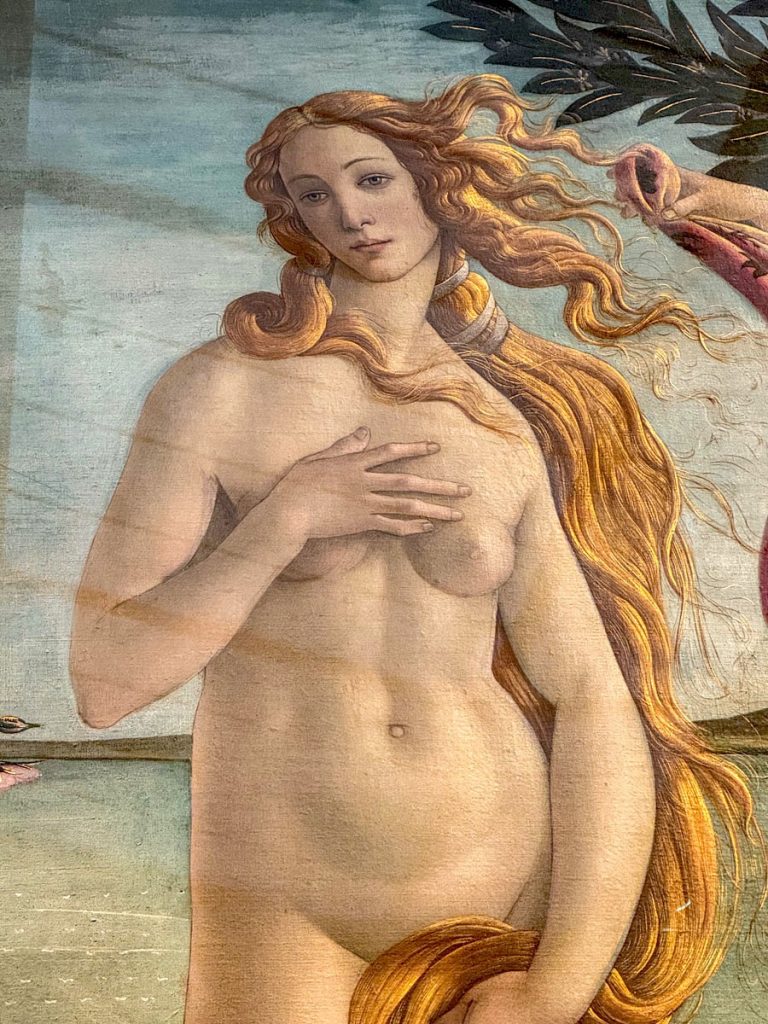
What makes these paintings unforgettable is not only their beauty but the physical experience of encountering them. The room is almost always crowded, a constant flow of visitors trying to find a clear view, yet the moment you finally stand in front of these iconic masterpieces, everything else seems to recede. Even with people shifting and cameras clicking, there is a brief, thrilling instant when the paintings seem to belong only to you — a private encounter with images that have shaped the world’s idea of beauty for centuries.
Michelangelo and Leonardo: Two Opposing Visions of Creation
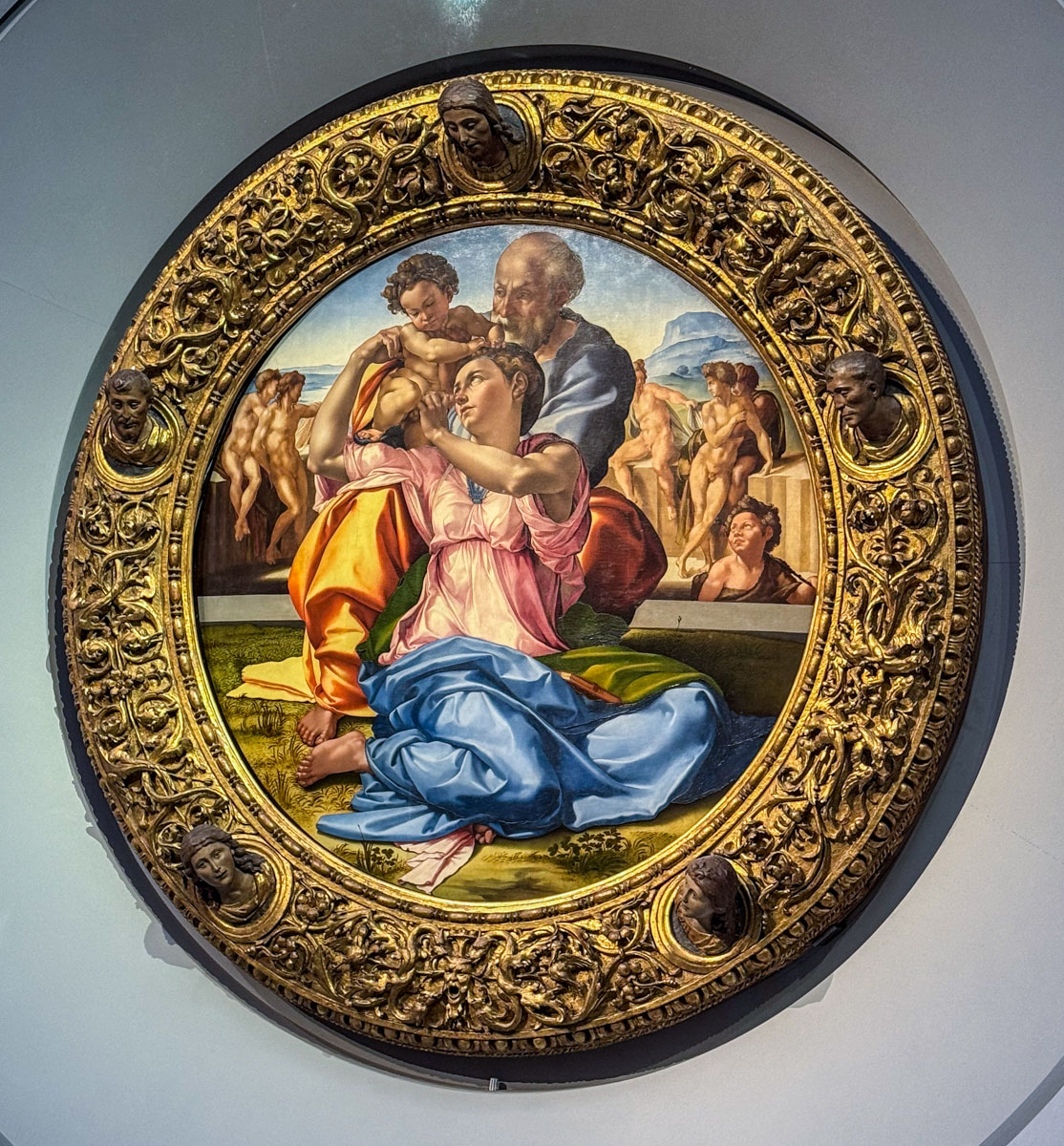
Michelangelo is represented in the Uffizi by a single work of extraordinary intensity: the Tondo Doni, the only surviving finished panel painting by his hand. Its circular format seems to concentrate the energy of the scene, drawing the figures into a tight, sculptural knot. Mary twists in a powerful, almost athletic movement as she lifts the Christ Child. The colors are vivid, the contours sharply defined, and the bodies carry the weight and tension of carved marble — a reminder that Michelangelo approached painting with the mind and discipline of a sculptor. Even the enigmatic group of nudes in the background feels like a meditation on the human form, a bridge between the spiritual subject and the artist’s lifelong fascination with anatomy and physical strength. This single painting is enough to show how radically Michelangelo reshaped the language of Renaissance art through movement, tension, and the unmistakable vitality of the human body.
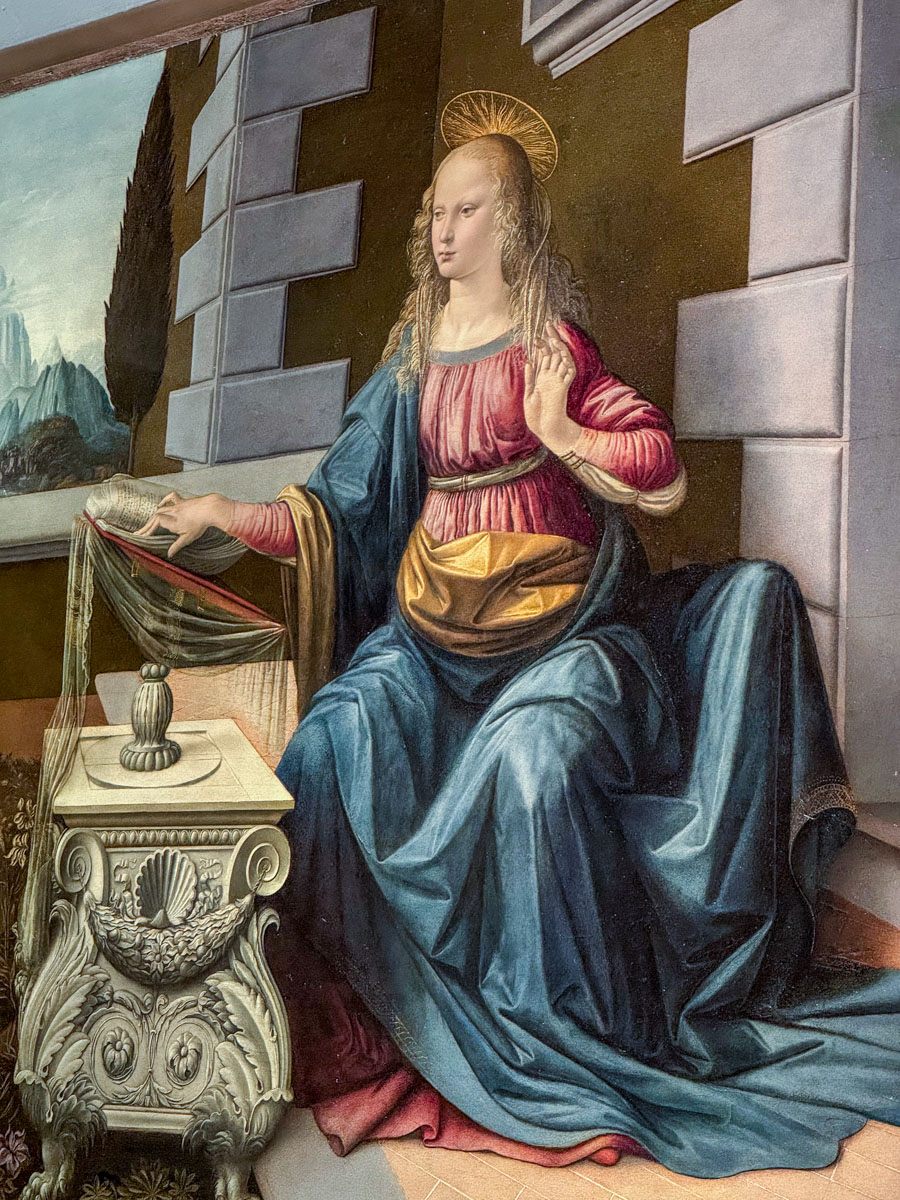
Leonardo’s paintings in the Uffizi feel like moments suspended between observation and imagination. His Annunciazione is a perfect example: the angel approaches with a quiet, almost hesitant grace, while Mary turns toward him with a gesture so subtle it seems to unfold in real time. The landscape behind them dissolves into soft blues and distant light, a world built from Leonardo’s fascination with nature and atmosphere. Even in this detail of the Madonna’s posture, you can see the delicacy of his sfumato, that gentle transition between light and shadow that gives her expression its calm, inward depth.
Nearby, the Adorazione dei Magi reveals a different side of Leonardo: restless, experimental, and endlessly curious. The unfinished surface exposes his thought process, the way he layered gestures, architecture, and swirling groups of figures to create a composition that feels alive even in its incomplete state. Together, these works show Leonardo searching for a new visual language, one that blends scientific observation with emotional nuance. They form a bridge between the clarity of the early Renaissance and the psychological complexity that later artists would explore in their own ways.
Raphael and Caravaggio: Balance and Contrast
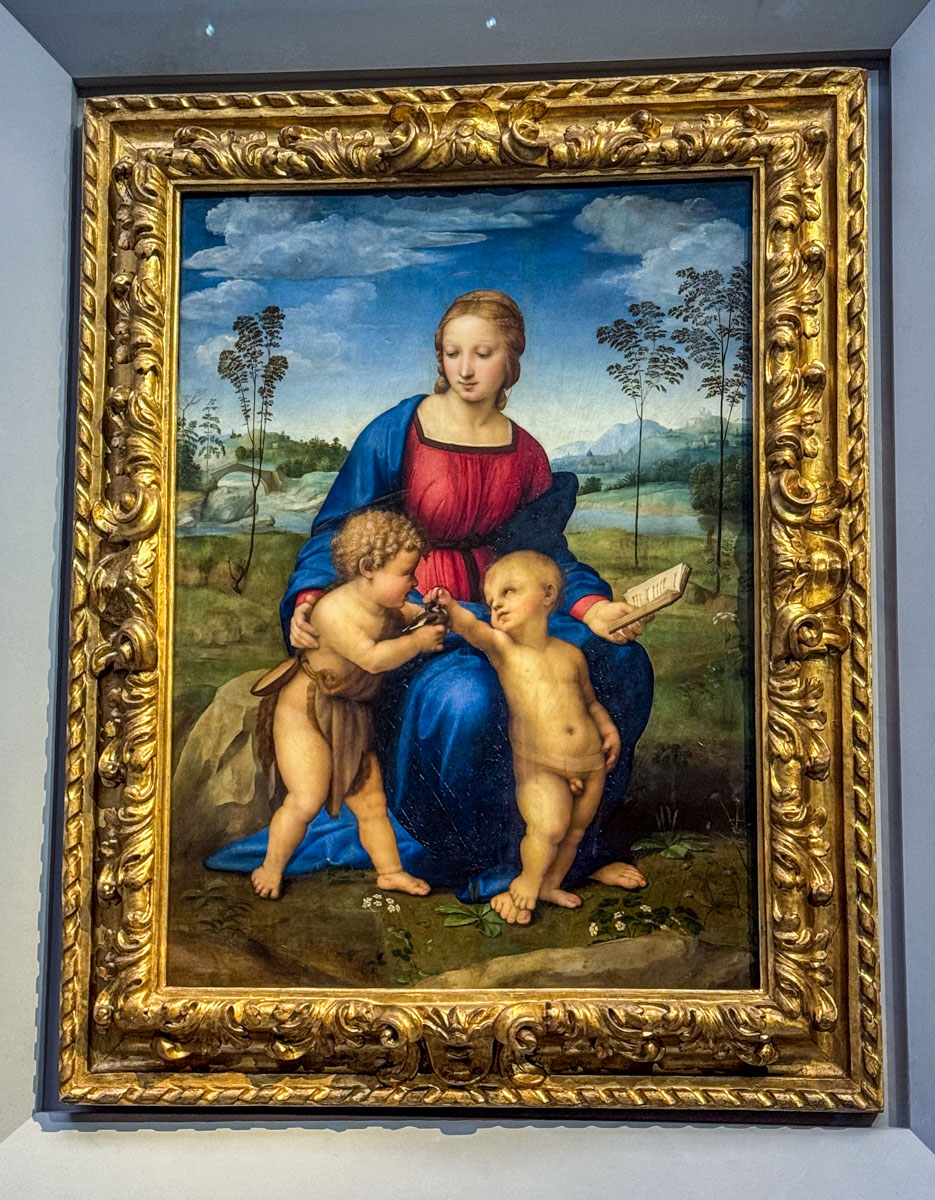
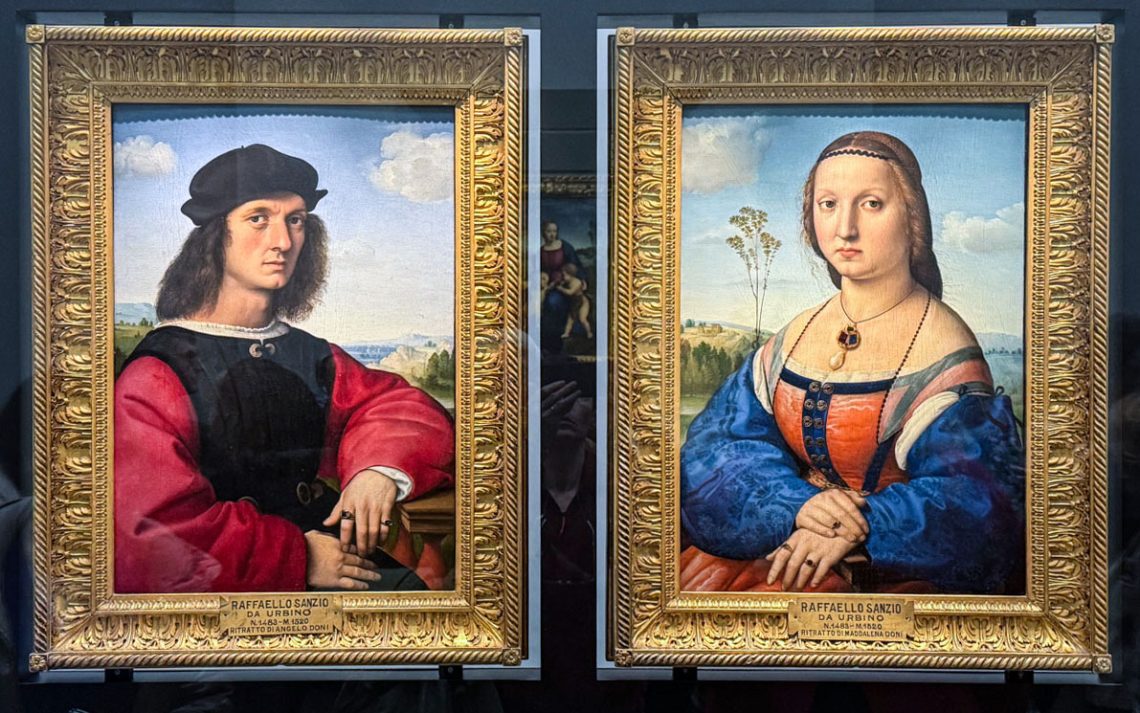
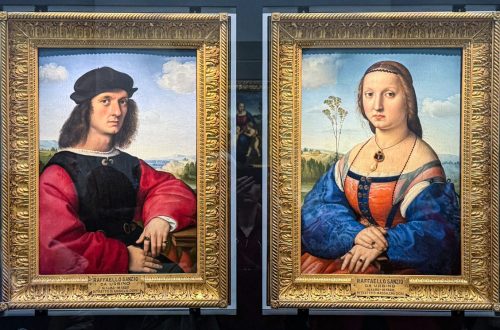
Raphael’s portraits offer a moment of quiet clarity. Their elegance lies not in ornament but in the psychological depth of the sitters, who seem to inhabit the space with a naturalness that feels surprisingly modern. This quality becomes especially clear in the Madonna del Cardellino, where the tenderness between Mary, the Christ Child, and the young John the Baptist is expressed through gentle gestures and a serene landscape that seems to breathe around them. The painting embodies the Renaissance ideal of misura — balance, proportion, and thoughtful restraint — yet it also reveals Raphael’s gift for creating scenes that feel intimate rather than idealized, as if the viewer were quietly invited into a private moment.
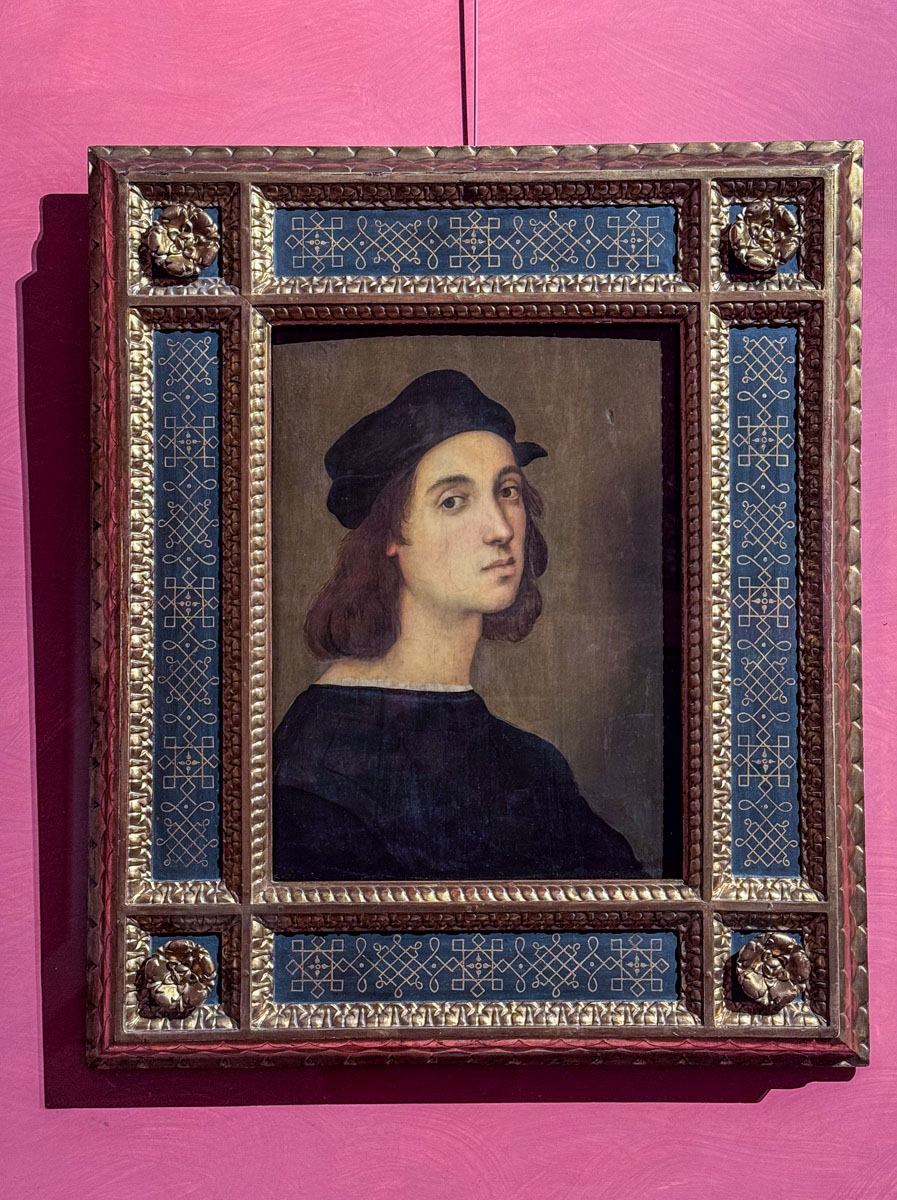
Raphael’s self‑portrait adds another layer to this experience: a young artist looking out with calm confidence, aware of his place within the evolving language of Renaissance art. These works form a small but powerful constellation within the Uffizi, offering a pause between the intensity of Leonardo and the drama of Caravaggio — a space where clarity, balance, and human presence quietly take center stage. Read more about Raphael in our article L’arte sublime di Raffaello: la Dama col liocorno (in Italian).
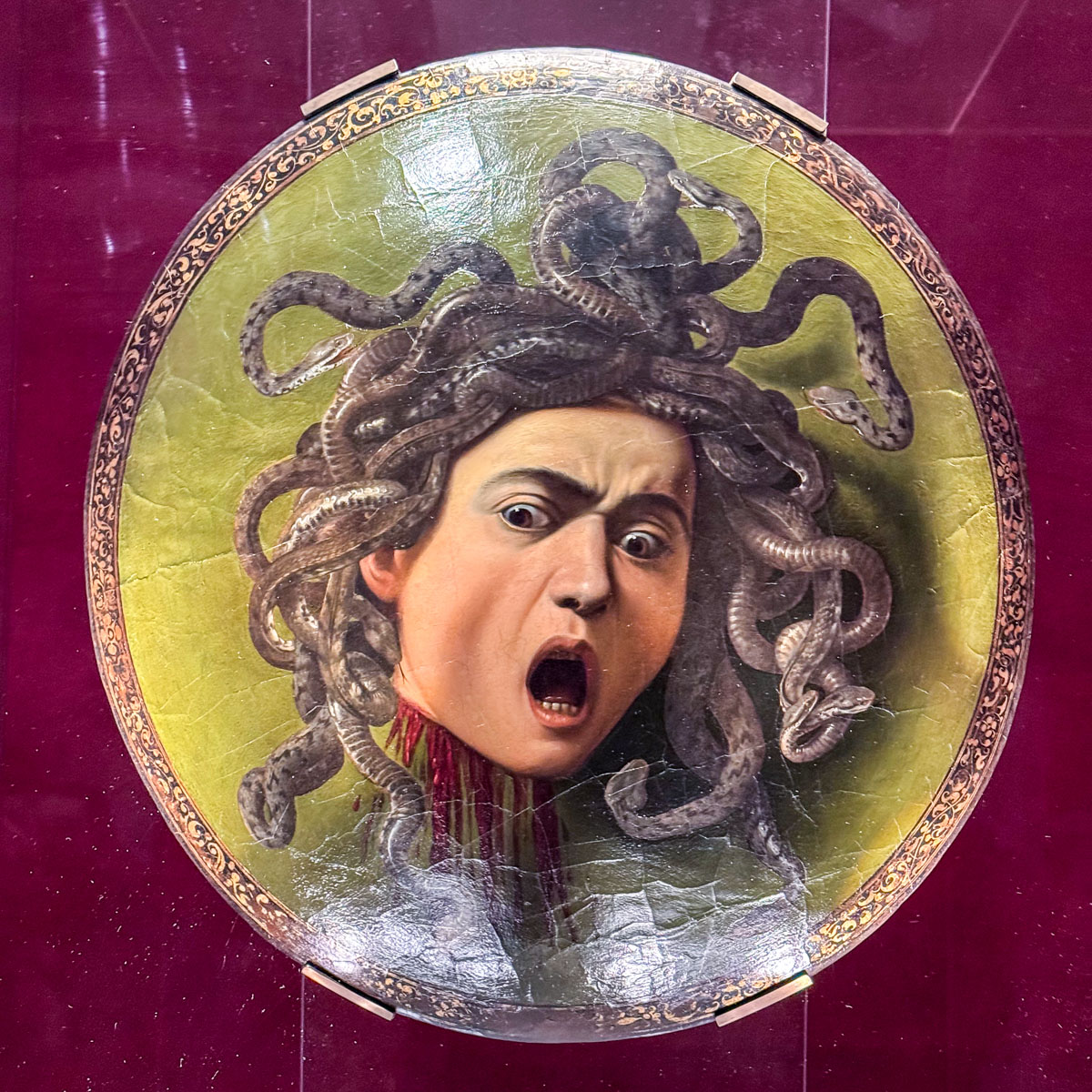
Caravaggio’s rooms in the Uffizi feel like a sudden plunge into a different emotional temperature. His paintings confront you with a world where light slices through darkness and human drama is stripped of every decorative veil. His Medusa, painted on a ceremonial shield, is one of the most unsettling images in the museum: the moment of decapitation frozen with terrifying immediacy, the head still alive in its final instant of shock. Caravaggio turns a myth into something disturbingly real, using his own face as the model and letting the chiaroscuro (contrast between light and darkness) carve out every detail with surgical precision.
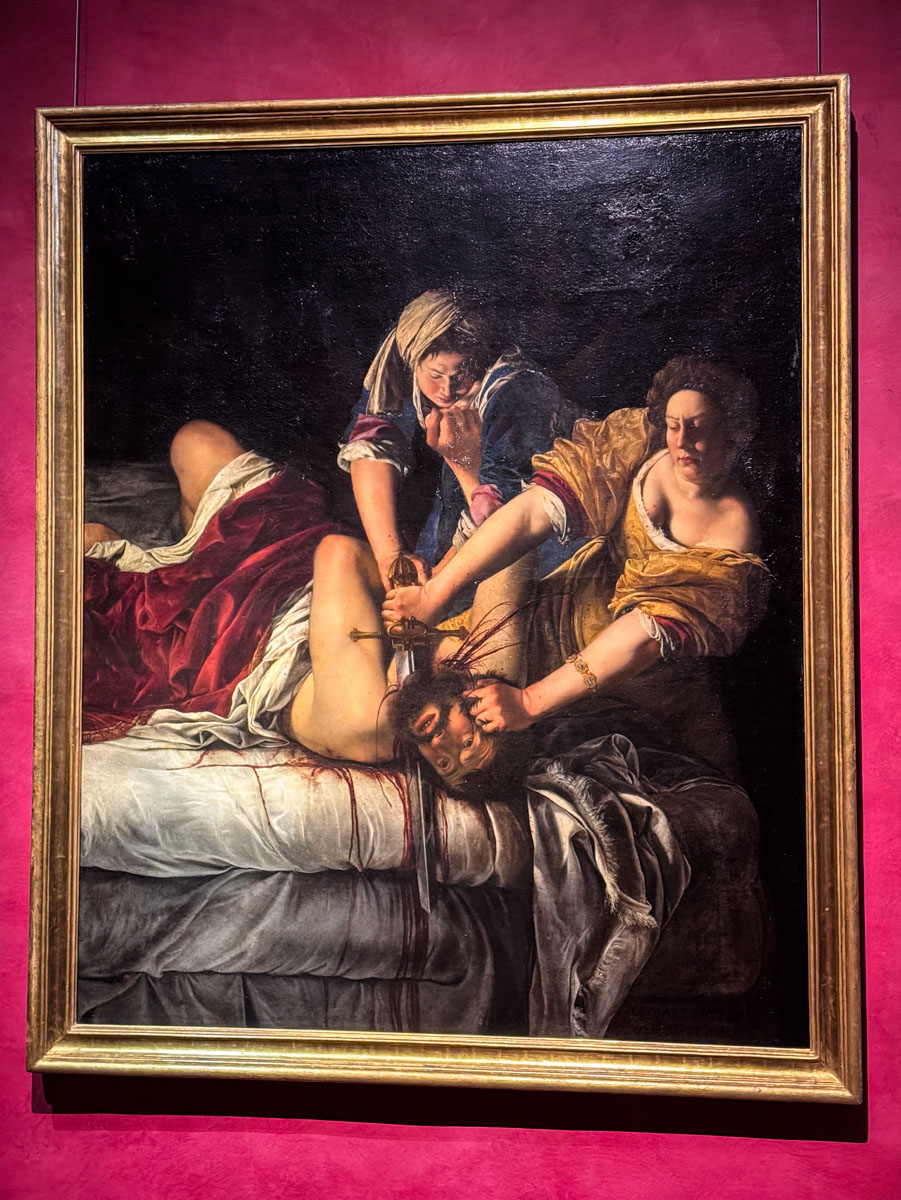
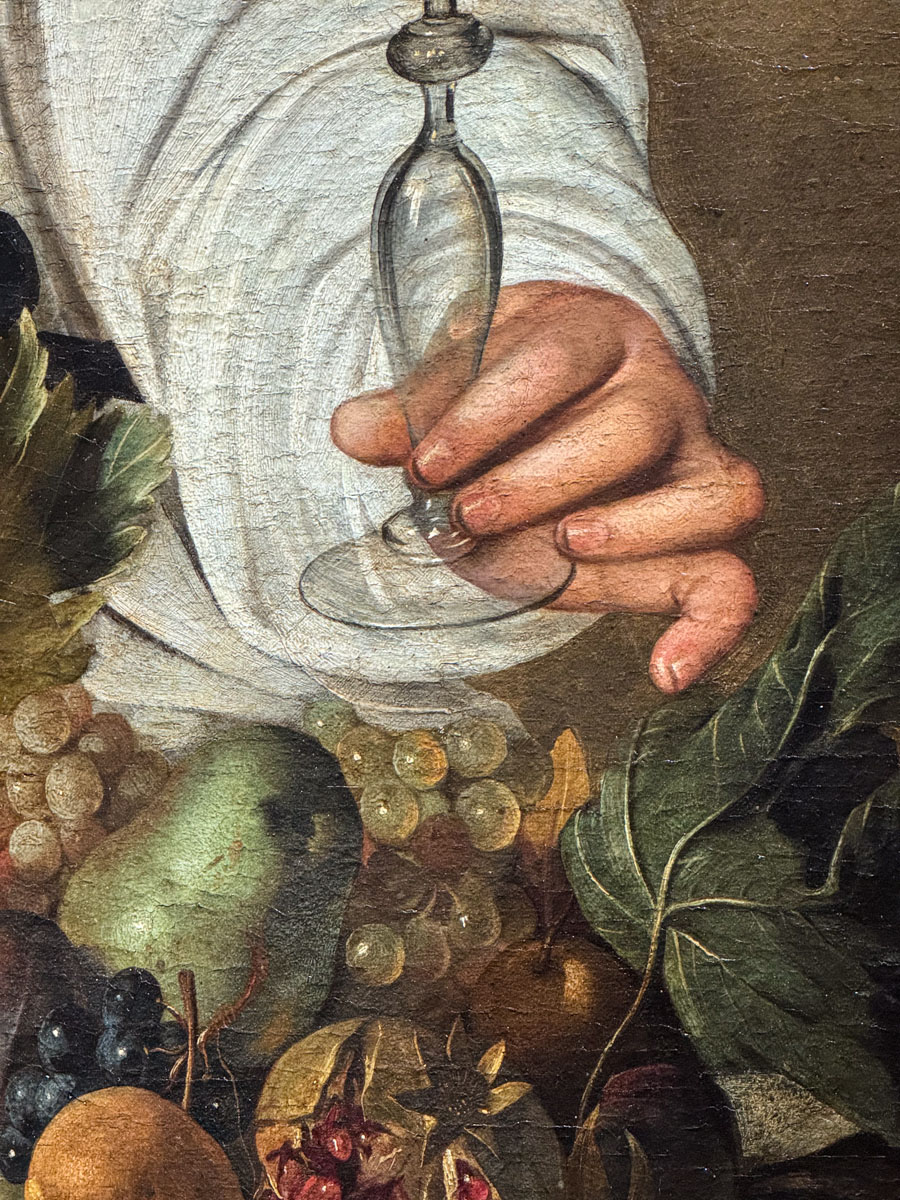
Nearby, Giuditta e Oloferne pushes this realism even further. Here the dark background heightens the drama, pulling the figures into sharp relief. The scene is intimate and brutal, illuminated by a single, merciless beam of light that exposes both the violence of the act and the psychological tension between the figures. Caravaggio’s genius lies in the way he makes you feel the weight of the moment, the moral complexity, the raw humanity beneath the biblical story. Standing before these works, you sense how radically he broke with tradition, opening a path that would redefine European painting for centuries.
Seeing Raphael and Caravaggio in close succession highlights how the Renaissance gradually opened the way to new forms of realism and emotional intensity. This is where the Italian word umanesimo — humanism — feels particularly relevant. The Renaissance was built on the belief that human experience, emotion, and intellect deserved to be at the center of artistic creation, and the Uffizi’s layout reflects that philosophy.
Passionate about art? You might enjoy our book and video course Learn Italian with Art – The Language of Renaissance Masterpieces, where we analyze six works from Italian Renaissance masters. A different way to improve your Italian, for late beginners and beyond.
Learn more and watch sample videos on our Website.
Practical Information for Your Visit
Tickets
The Uffizi Gallery is extremely popular, and many unofficial websites sell overpriced “priority” tickets or tours that look like the only option. To avoid this, always book through the official Gallerie degli Uffizi website:
👉 Official tickets: https://www.uffizi.it/biglietti
This is the only site that offers standard prices and timed entry without extra fees.
What you’ll find on the official site
- Free entry on the first Sunday of the month (very crowded)
- Timed-entry tickets for the Uffizi
- Combined passes (Uffizi + Pitti Palace + Boboli Gardens)
- Reduced tickets for EU visitors aged 18–25
Duration
A focused visit takes about two to three hours, but spending half a day allows you to explore at a comfortable pace and revisit the rooms that interest you most.
Best Times
Weekday mornings and late afternoons tend to be quieter. The low season (November to February) offers a more relaxed experience.
Accessibility
The museum provides accessible routes and elevators. It’s a good idea to check the official website for updated information.
Audio Guides
Given the number of important works, an audio guide or a guided tour can help you navigate the collection without feeling overwhelmed.
A Pause with a View
The rooftop café offers a terrace overlooking Florence — a pleasant break and a good opportunity to take in the city from above.
A Brief Historical Note
The Uffizi began as a practical project rather than a museum. In 1560, Cosimo I de’ Medici commissioned Giorgio Vasari to design a new administrative complex for Florence — the uffizi, or “offices”. The long, narrow courtyard between the two wings was intentionally aligned with the river to create a sense of openness in a dense medieval city. Over time, the upper floor became a private gallery where the Medici displayed portraits, ancient statues, and the works of contemporary Florentine artists.
When the Medici dynasty ended, their last heir, Anna Maria Luisa de’ Medici, signed the Patto di Famiglia, ensuring that the family’s artistic collections would remain in Florence “for the ornament of the State, for the utility of the Public, and to attract the curiosity of Foreigners”. This gesture transformed the Uffizi from a private treasure house into a public institution.
A visit to the Uffizi is an opportunity to see some of the most influential works of Western art in their original context. When you finally step back into the streets of Florence, the experience lingers in a way that is difficult to articulate. Perhaps it is a color, a gesture, or a face that stays with you; perhaps it is the realization that the Renaissance is not a distant chapter in a textbook but a living conversation that continues each time someone stands before a painting and truly looks.
At the Uffizi Gallery, there is a lot more that will catch your eye, of course. Masaccio, Beato Angelico, Piero della Francesca, Mantegna, Tiziano, Tintoretto, Paolo Veronese; a stunning collection of self-portraits; Rembrandt and other Dutch and Flemish masters; a room devoted to Painting by Candlelight.
Tell me about your expectations and experience. Buona visita!
Diana


Grazie per la descrizione sensitiva e intelligente della galleria d’arte. Non visitavo ancora l’Uffizi, ma è un luogo che vorrei vedere. Ho visitato Firenze come un turista alcuni anni fa e il centro era molto occupato. Tuttavia, ne è valsa la pena per vedere il Davide di Michaelangelo e le porte del Battistero.
Ciao David, pensa che io sono stata agli Uffizi per la prima volta solo qualche mese fa, e ne avrei avute di occasioni per andare prima, perché con i treni ad alta velocità Firenze ormai è vicinissima! Questa volta era febbraio, pioveva e c’erano pochissimi turisti. Dopo gli Uffizi sono andata anch’io alla Galleria dell’Accademia a vedere il tuo omonimo 😉