• Italian Grammar

    Italian Pronouns: A Simple Guide to Identify and Use Them Correctly

    Reading Time: 5 minutes

    What is a pronoun? A pronoun is a tiny word that replaces a noun, usually to avoid repetition, like she, him, them, it. Italians hate redundancy, especially in writing, so we use pronouns a lot. Pronouns are introduced early on, at the A1 level, but they are a tricky topic: let’s learn how to identify and use them correctly!

    In Italian there is considerable overlapping between different kinds of pronouns, which can be helpful and confusing at the same time. As always, practice is key, but understanding the grammatical function of these little words is crucial: you need to know what a direct object is and be able to identify it in a sentence. No worries! Practical examples will make everything clear. Then you can test yourself with exercises on our YouTube channel.

    Subject pronoun
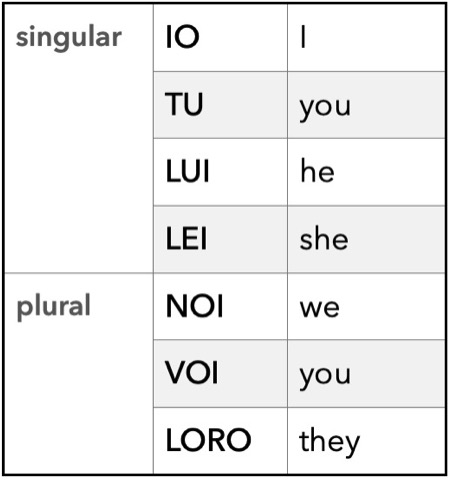
    Subject pronouns in Italian

    Grammar experts disagree on the exact definition of the term subject, but for our purposes it will suffice to say that the subject is the person, animal or thing that performs the action expressed by the verb. Subject pronouns have the same function:

    Luca prende l’autobus. Lui va a scuola. – Luca takes the bus. He goes to school.

    Luca is a subject. Lui is a subject as well, but it’s a pronoun. We use it to avoid saying Luca again.

    Very important: in Italian, the subject is often omitted, because the verb already contains information about it. We use subject pronouns only for emphasis or contrast. For example:

    Io vado al lavoro e lui dorme tutto il giorno! – I go to work and he sleeps all day.

    Chi va a prendere la pizza? Ci vado io! – Who’s going to pick up the pizza? I’ll go!

    In the sentence above, the subject pronoun is emphasised by its position after the verb: ci vado io.

    When reading a book, you may stumble upon old-fashioned forms of subject pronouns: egli for lui, ella for lei, essi for loro. These are the original forms of subject pronouns, but they are uncommon in speech. The pronoun esso translates the English it and applies to inanimate objects, but is not very common either.

    Direct object pronouns

    Direct object pronouns replace the direct object of a verb, i.e. the person or thing that receives the action and answers the question Whom? or What?

    Direct object pronouns have two forms, stressed (forti) and unstressed (deboli). The stressed form is used for emphasis and follows the verb, while the unstressed form, which is more common, comes before the verb.
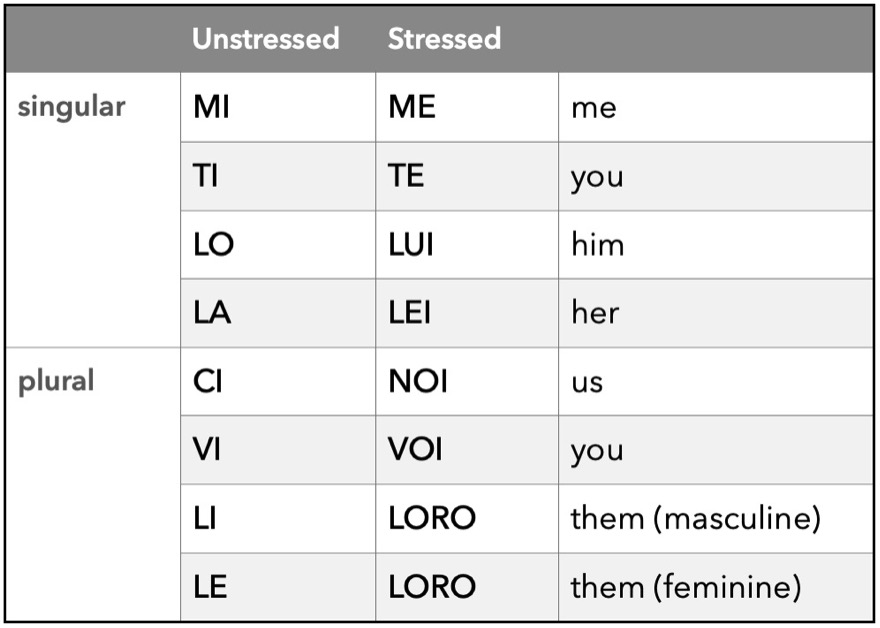
    Direct object pronouns in Italian

    Some example sentences:

    • Il mio cane mi segue sempre. — My dog follows me at all times.
    • Il mio cane segue me, non te. — My dog follows me, not you.
    • Quel bambino ci guarda. — That child is looking at us.
    • Quel bambino guarda noi, non loro. — That child is looking at us, not at them.

    Attenzione! If the verb is in the infinitive, gerund or imperative, unstressed pronouns are attached to the verb:

    • Bambini, seguitemi! (= seguite me) — Children, follow me! (imperative)
    • Quel bambino continua a guardarci. ( = a guardare noi) — That child keeps looking at us. (infinitive)

    Indirect object pronouns

    An indirect object is the person or thing that receives the direct object (if any) and answers the question To whom? or To what? Indirect objects are called indirect because there is a preposition between them and the verb, while direct objects do not need prepositions, they directly follow the verb. Indirect object pronouns replace the indirect object of a verb.
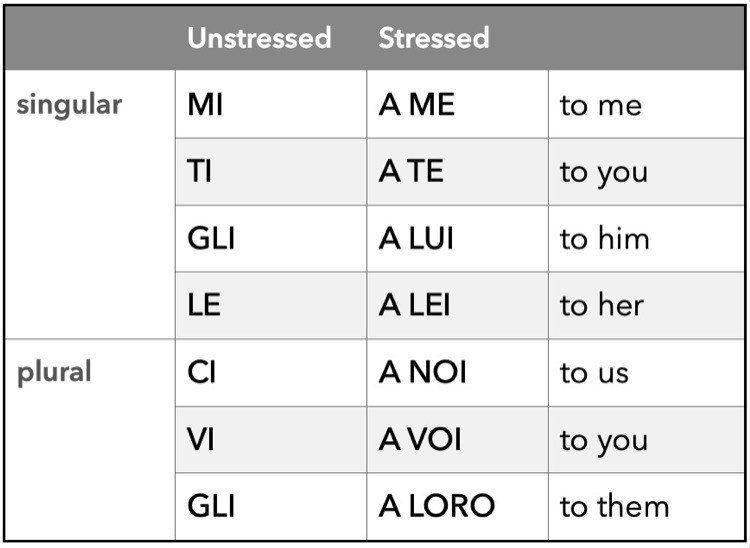
    Indirect object pronouns in Italian

    Keep in mind that verbs that are followed by direct object pronouns in English may require indirect object pronouns in Italian and viceversa. Telefonare works like this:

    Più tardi telefono a Luca. — Later I will phone/call Luca.

    Let’s replace Luca with a pronoun: Più tardi gli telefono. — I will phone/call him later.

    Here, gli is an indirect object pronoun. The English verb is followed by a direct object, him, but in Italian the verb is followed by the preposition a, to, so we need an indirect object. We cannot say: Più tardi *lo telefono, we must say Più tardi gli telefono. This is a very common mistake.

    Like direct object pronouns, indirect object pronouns also have two forms, stressed (forti) and unstressed (deboli). The stressed form usually follows the verb + preposition, while the unstressed form comes before the verb, but is attached to it when the verb is in the infinitive, gerund or imperative.

    Tip: stressed indirect pronouns are the same as stressed direct pronouns, but they come after a preposition; unstressed indirect pronouns are the same as unstressed direct pronouns, except for the third person singular and plural.

    Some example sentences with unstressed indirect pronouns and the related stressed forms:

    • Anna sta mentendo, non le credo. ( = non credo a lei) — Anna is lying, I don’t believe her.
    • Vi piace la pizza? (= A voi piace la pizza?) — Do you (plural) like pizza?
    • Questa borsa non mi serve più. (= non serve più a me) — I no longer need this bag.
    • Ci hanno spedito un pacco. (= Hanno spedito un pacco a noi) — They sent us a parcel.
    • Ti voglio tanto bene! (= Voglio tanto bene a te) — I really care for you!

    What happens if the preposition that follows the verb is not a, but another one, for example con, with, or per, for? We use stressed pronouns: 

    • Aspettami, vengo con te! — Wait for me, I’m coming with you!
    • Questo regalo è per lei. — This present is for her.

    Reflexive pronouns
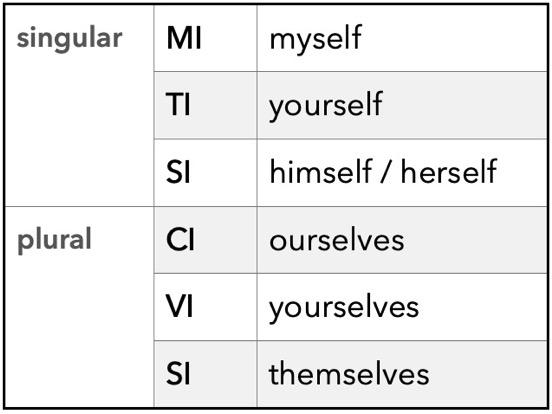
    Reflexive pronouns in Italian

    Reflexive pronouns are used with reflexive verbs, i.e. verbs whose action affects the subject or reflects on the subject. These verbs are quite common in Italian: you can read this article to learn more about them.

    Reflexive pronouns come before the verb but can be attached to it when the verb is in the infinitive, gerund or imperative:

    • Ti alzi presto. — You get up early.
    • Ti devi alzare presto. / Devi alzarti presto. — You have to get up early.
    • Gianni si veste. — Gianni gets dressed.
    • Gianni si sta vestendo. / Gianni sta vestendosi. — Gianni is getting dressed.

    Once again, notice how reflexive pronouns are the same as unstressed direct object and indirect object pronouns, except for the third person singular and plural. This overlapping makes it harder to identify their function in a sentence, but makes it easier to memorise them.

    Sometimes multiple pronouns are used together, and pronouns can be used with the particles ci and ne. We will discuss this topic – i pronomi combinati – in a separate article!

    I hope this clarified the basic concepts for you. Ask me questions in the comments if you have any! I’ll see you soon on YouTube and on this website.

    Anna

    Related video lessons:

  • Cultura e società

    Understand Italian Movies Better!

    Reading Time: 13 minutes

    Ciao a tutti at My Italian Circle!

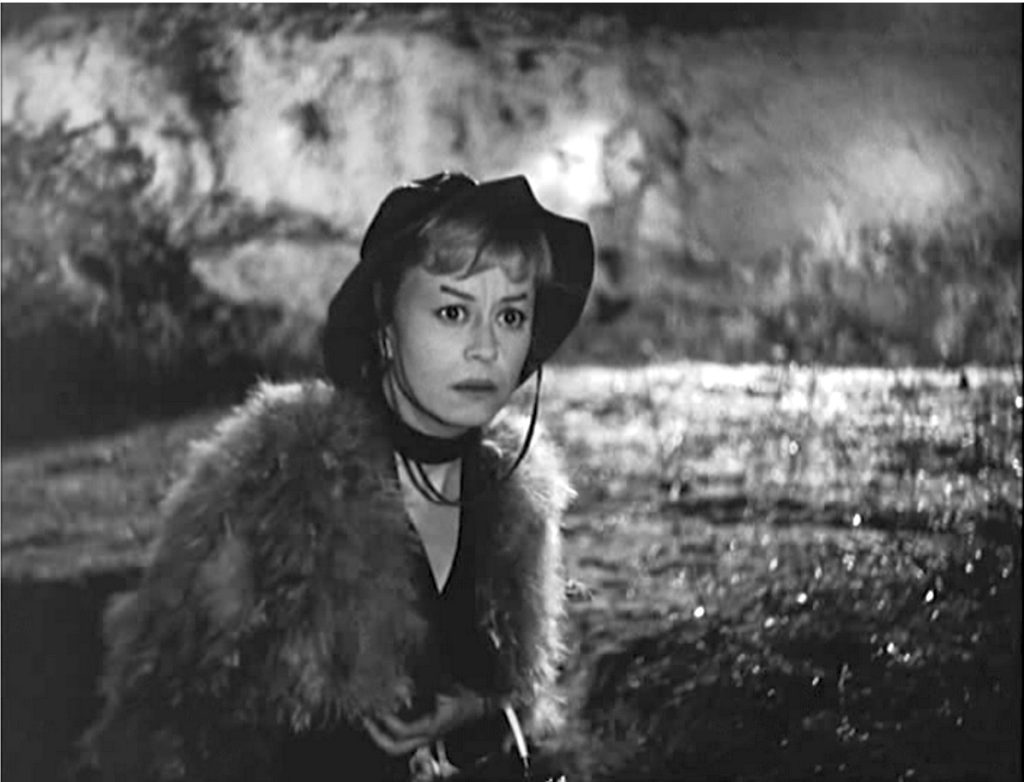
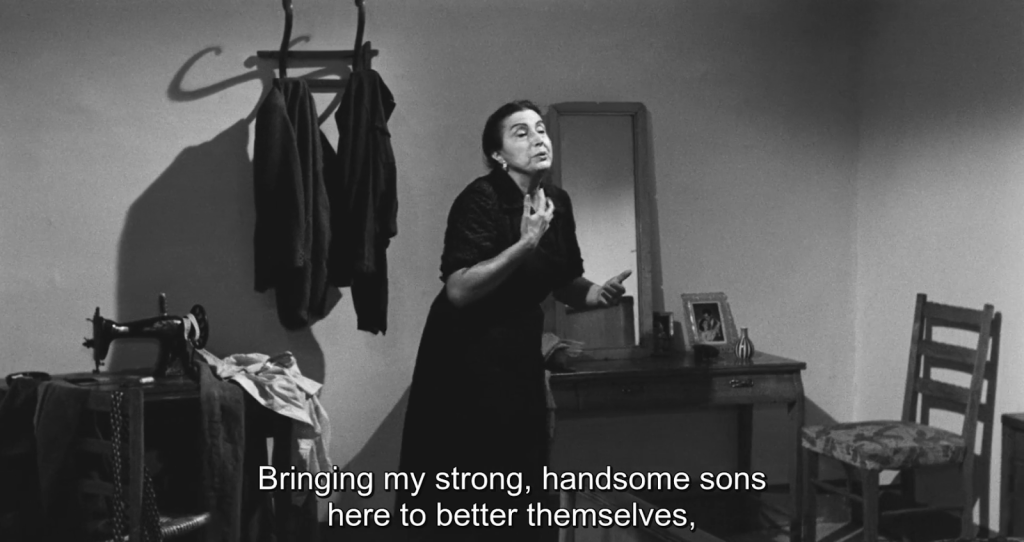
    If you’re reading this, you probably love the Italian language, and maybe you also love old Italian movies, as I do. In this article, I outline certain themes that often appear in movies made from the 1940s through the 1970s, such as language differences; the dichotomy between North and South; emigration; and the post-war economic boom. Often, these themes might pass unnoticed without some understanding of the cultural background. The information I provide here lays the basis for a deeper appreciation of the films. For example, when you see a film where a northerner makes a disparaging remark about a southerner, or where an Italian emigrant misses home, you’ll know that these are themes of Italian life and culture, and not just the experience of a single individual.

    I illustrate the themes with images from some of my favorite Italian films, which include Italian subtitles translated, in some cases, from dialect. I’ve included links to the cineracconti (photo-stories) on my blog www.liconoscevobene.net, where, if your curiosity is piqued, you can read a narrative of each film, complete with dialogue, scene description, cultural notes, and images. 

  • Learn Italian

    Certificazione B1 Cittadinanza: cos’è e come è fatto l’esame

    Reading Time: 4 minutes

    L’esame B1 Cittadinanza è l’esame necessario per ottenere la cittadinanza italiana. Chi deve farlo? Quali sono le prove dell’esame e come bisogna prepararsi? Oggi risponderò a tutte queste domande.

    1. La cittadinanza italiana: residenza, matrimonio, discendenza

    La certificazione linguistica di livello B1 Cittadinanza è quella richiesta per ottenere la cittadinanza italiana per residenza o matrimonio: oltre a tutti i documenti che devi presentare, devi anche fare un esame per dimostrare che conosci abbastanza bene l’italiano.

  • Italian Grammar

    The Trapassato Prossimo: When Something Happened Before Something Else

    Reading Time: 3 minutes

    Have you ever told a story about the past… but starting from before the main event? Welcome to the fascinating world of the trapassato prossimo, the Italian past perfect. This tense lets you describe an action that happened even earlier than another past action.

    La tensione cresce

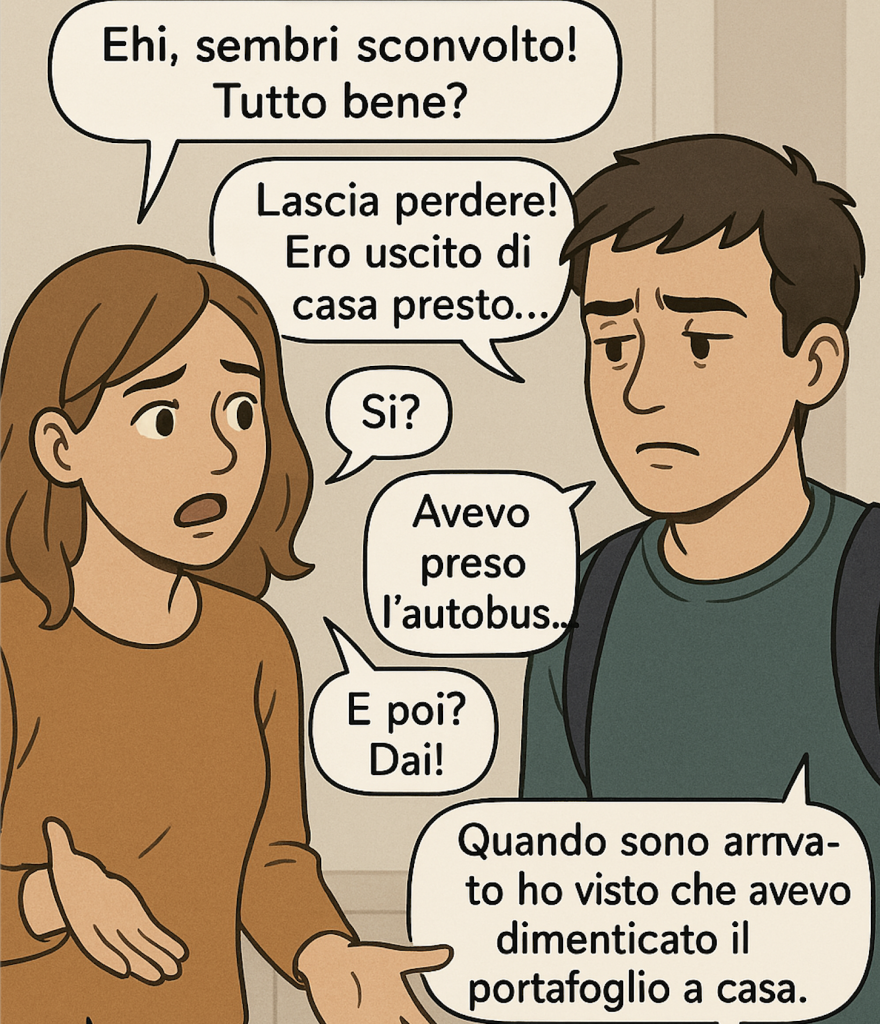
    Let’s read a short exchange between two friends, Marco and Giulia:

    Giulia: Ehi, sembri sconvolto! Tutto bene?
    Marco: Lascia perdere! Ero uscito di casa presto…
    Giulia: Sì?
    Marco: Avevo preso l’autobus…
    Giulia: E poi? Dai!
    Marco: Quando sono arrivato ho visto che avevo dimenticato il portafoglio a casa.
    Giulia: Ma no! E cosa hai fatto?
    Marco: Niente… sono tornato indietro, ma a quel punto avevo già perso il colloquio di lavoro.

    Giulia: You look upset! Everything okay?
    Marco: Don’t even ask… I had left the house early…
    Giulia: Yeah?
    Marco: I had taken the bus…
    Giulia: And then? Come on!
    Marco: When I got there I saw that I had forgotten my wallet at home.
    Giulia: Oh no! What did you do?
    Marco: Nothing… I went back, but by then I had already missed the job interview.

    Can you see what’s happening? Marco builds tension using the trapassato prossimo, and only later reveals what happened in the end. 

    So, What Is the Trapassato?

    In English, we call it the past perfect. In Italian, it’s formed like this:

    Imperfetto of “essere” or “avere” + past participle of the main verb.

    Examples:

    1. Avevo mangiato prima di uscire. – I had eaten before going out.
    2. Era arrivata troppo tardi. – She had arrived too late.

    We use the trapassato to show that an action happened before another one in the past.

    Sequence of past events; describing a state

    1. Sequence of past events

    Quando siamo arrivati, il film era già iniziato.
    When we got there, the film had already started.

    Ho perso il cellulare che avevo appena comprato.
    I lost the phone that I had just bought.

    2. With the imperfetto (describing a state)

    Ero triste perché avevo ricevuto una brutta notizia.
    I was sad because I had received bad news.

    Volevo uscire, ma avevo dimenticato l’ombrello.
    I wanted to go out, but I had forgotten my umbrella.

    Be Careful with “prima di…”

    If the subject of the sentence stays the same, you can use the trapassato with prima di + infinitive:

     Avevo già fatto la spesa prima di tornare a casa.
    I had already done the shopping before going home.

    Luca aveva studiato molto prima di sostenere l’esame.
    Luca had studied a lot before taking the exam.

    The “Polite” Trapassato

    Yes! Italians sometimes use the trapassato to sound more polite, especially in shops or formal situations:

    Scusi, avevo visto una giacca rossa ieri… è ancora disponibile?
    Excuse me, I had seen (= I saw) a red jacket yesterday… is it still available?

    Ero venuto per chiedere un’informazione…
    I had come (= I came) to ask for some information…

    In these cases, you can also use the passato prossimo instead, and the meaning stays the same:

    Scusi, ho visto una giacca rossa ieri…
    Sono venuto per chiedere…

    Using It Alone (With mai)

    Sometimes the trapassato is used on its own, when the context makes the meaning clear. This often happens with the word mai (never):

    Buono questo dolce! Non lo avevo mai assaggiato.
    This dessert is great! I had never tasted it before.

    Marco non era mai stato a Roma prima d’ora.
    Marco had never been to Rome before now.

    Let’s Recap!

    Use the trapassato prossimo to:

    1. Talk about past actions that happened before other actions in the past.
    2. Describe emotional states or situations caused by earlier events.
    3. Make polite requests in formal or service situations.
    4. Express something that had never happened until that moment (often with mai).

    Would you like to practice? Try writing a short story using at least three verbs in the trapassato prossimo. If you want, send it to me and I’ll give you some feedback. Don’t forget to watch our video lesson on this useful tense!

    Anna

  • Italian Grammar

    Gli articoli determinativi: How to Use Definite Articles in Italian

    Reading Time: 4 minutes

    L’amore. Gli spaghetti. La nonna. Il vino. L’Italia. What are the little words you see before all these nouns? They all mean the; they are all definite articles. What are they and why so many different ones? How to use definite articles in Italian? In this article I will answer these questions and I will help you make sense of this tricky feature of the Italian language.

    What are definite articles?

    Basic rule, which applies to many different languages, including English: definite articles are used to refer to a specific thing or person. So:

    THE house you see is mine. = LA casa che vedi è mia.

    THE black dog is mine. = IL cane nero è mio.

  • Learn Italian

    Learn Italian Quickly? The Best Way to Learn Italian

    Reading Time: 5 minutes

    Learn Italian quickly! Learn Italian in 30 minutes! No, in 5 minutes! Learn Italian in your sleep! Become fluent in 2 months! In 2 weeks! Speak Italian now!

    So… we are all keen on doing things quickly nowadays — we want to learn new things and squeeze as many activities as we can into our busy days. Is this the right attitude to learn a language? Is it the best way to learn Italian? We are all looking for a secret recipe that will make it quick and easy, but what is it? I will tell you my ‘secret’ below.

  • Luoghi d'Italia

    Cremona: dove nascono i violini – The Birthplace of the Violin

    Reading Time: 4 minutes

    Carissimi, oggi voglio accompagnarvi in un’altra cittadina italiana al di fuori dei circuiti turistici, una meta imperdibile per tutti gli amanti della musica classica e non solo. Vi porterò dove nascono i violini.

    Stradivari, Guarneri, Amati

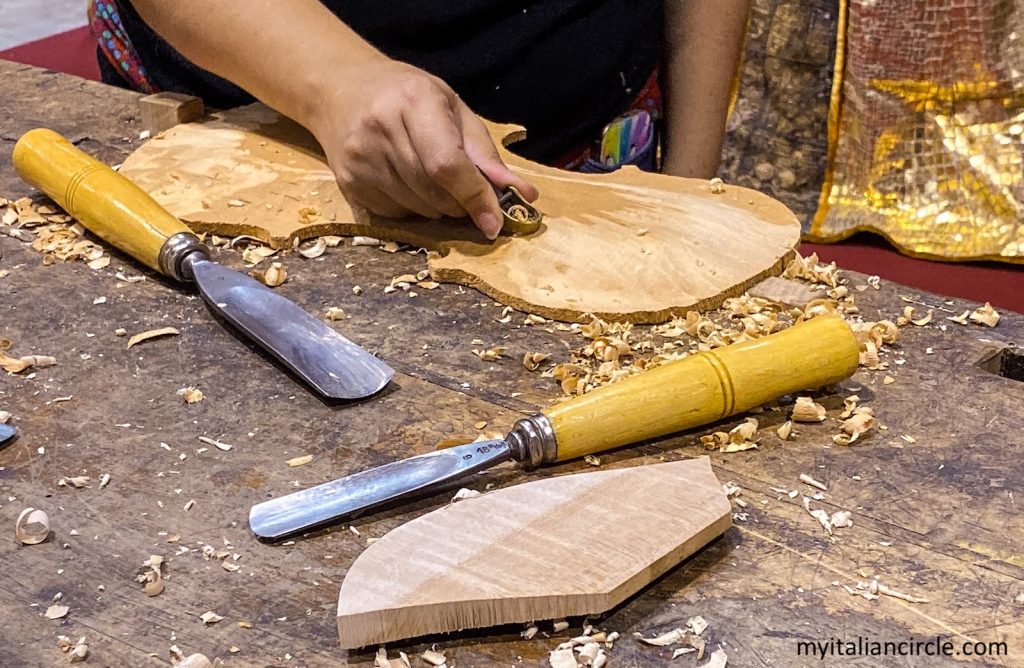
    Come si costruisce un violino? Vi siete mai posti questa domanda? La risposta la trovate a Cremona, una cittadina lombarda nel cuore della Pianura Padana, dove l’arte della liuteria ha conosciuto il massimo splendore tra il Seicento e il Settecento.

  • Cultura e società

    Love Classic Italian Cinema? Learn Italian with This Blog

    Reading Time: 6 minutes

    Ciao a tutti!

    I write the blog Liconoscevobene.net,* which consists of cineracconti (photo-stories) about classic Italian movies, some famous, some obscure. I started the blog out of a  passion for those movies and for the Italian language, as a way to share them with other Italian language students. Using the skills I learned in working on my Masters degree and in many years of Teaching English as a Second Language, I tailor the writing to students’ needs.

    The cineracconti are published in serial format. Each puntata (installment) is about 600 English words – about half the length of this post – or ten minutes of film. The blog aims to be a fun and useful tool for Italian language students, especially those who love movies. The puntate published after September 2001 have the Italian and English side by side; prior to that there is a separate PDF document with the English translation.

  • Cultura e società - Varie

    Il passaporto italiano: un sogno infranto?

    Reading Time: 3 minutes
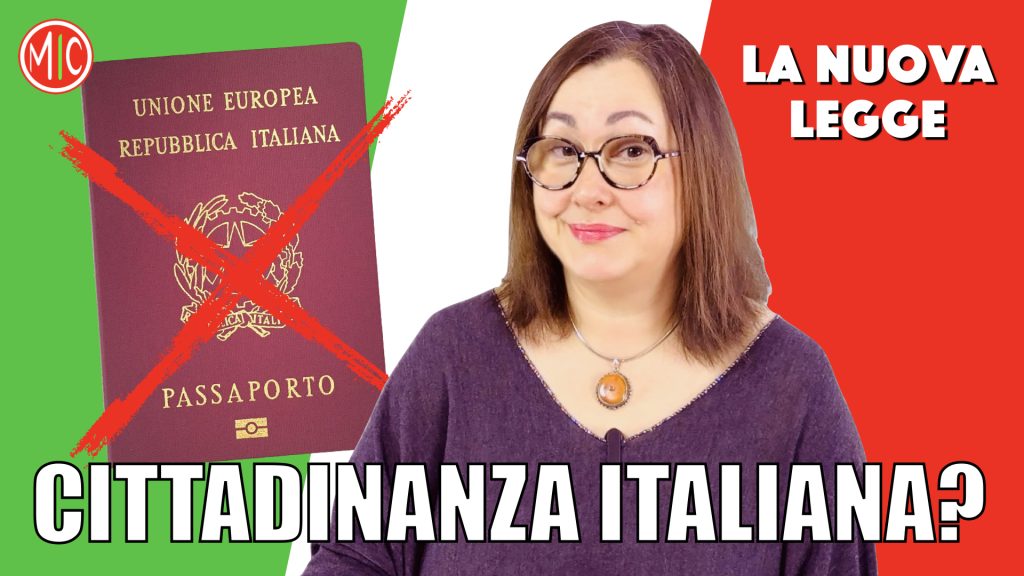
    Nuova legge cittadinanza italiana

    Che cos’è un sogno infranto? È un sogno che non si può realizzare. E questa è la dura realtà per molti cittadini stranieri di origine italiana, che hanno sperato per lungo tempo di ottenere la cittadinanza del Bel Paese. (Se ti stai domandando quale sia il Bel Paese, te lo dico io: è l’Italia!) La nuova legge sulla cittadinanza italiana per molti è una nuova, dura realtà.

    Un viaggio attraverso il tempo

    Con la vecchia legge, era sufficiente dimostrare di avere un antenato (una persona della tua famiglia vissuta molto tempo fa) italiano per chiedere la cittadinanza italiana. Questo antenato doveva essere nato in Italia dopo il 17 marzo 1861. Per noi italiani questa data è molto importante: è il giorno in cui Vittorio Emanuele II di Savoia, Re di Sardegna e Piemonte, uno dei principali promotori del movimento indipendentista italiano, diventò il primo Re d’Italia. (un re è una persona che governa un paese per diritto di famiglia, come Re Carlo d’Inghilterra). Questa legge era un filo che legava i discendenti degli italiani nel mondo a quel momento unico nel passato, quando l’Italia è diventata un paese unito e indipendente!

  • Luoghi d'Italia

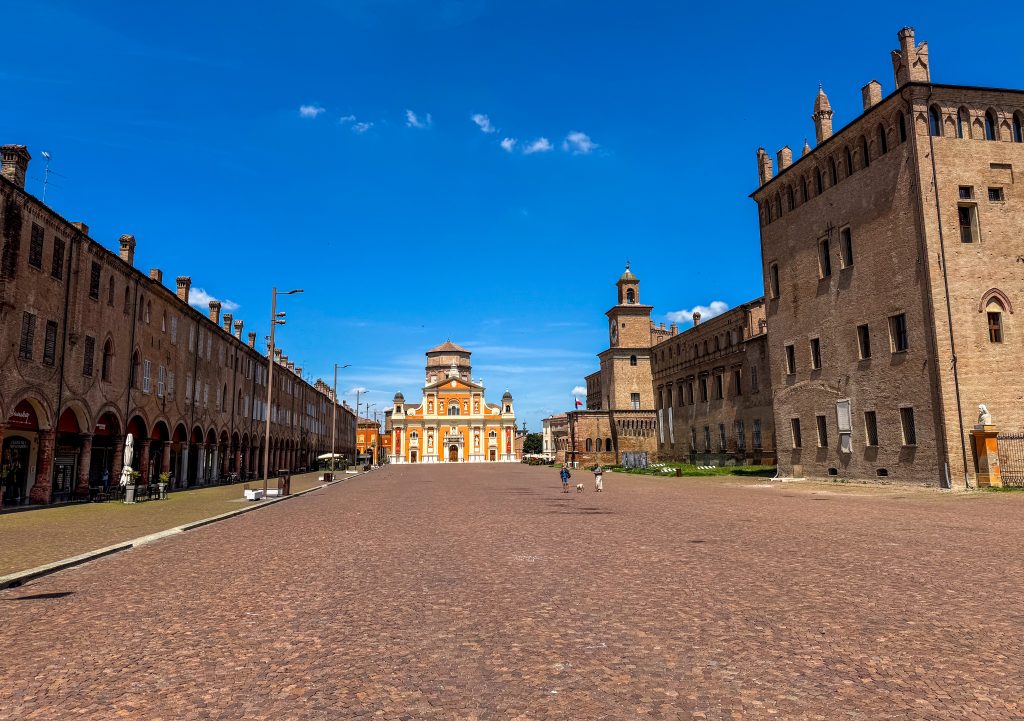
    Qual è la piazza più grande (e più bella) d’Italia?

    Reading Time: 4 minutes

    Qual è la piazza più grande d’Italia? In quale città si trova? C’è piazza San Marco a Venezia, naturalmente; piazza Bra a Verona e piazza Duomo a Milano; a Roma ci sono piazze grandissime, e così a Napoli e a Torino; molte di queste però sono in realtà grandi incroci trafficati, oppure dei giardini.

    Cos’è la piazza per gli italiani

    In Italia la piazza è il luogo d’incontro per eccellenza, una di quelle cose che mancano tanto agli italiani che vivono all’estero, insieme al suono delle campane. La piazza è il luogo in cui lo sguardo spazia, l’orizzonte si apre, la città respira: deve essere pedonale, senza automobili strombazzanti e motorini rombanti, deve essere sgombra e aperta. Oggi voglio parlarvi di una cittadina poco nota che ospita una delle piazze più grandi e più belle d’Italia, una piazza come Dio comanda!