
If you are wondering how to study Italian in 2026 without burning out or giving up, this guide is for you.
Every year, the same thing happens. Learners of Italian around the world start off with great enthusiasm, diving into a full immersion of apps, videos, textbooks, podcasts and grammar guides, often without a clear learning path.
This initial phase of binge learning creates a powerful but deceptive feeling of progress. For a short time, everything seems to work. Then life gets in the way: lessons are skipped, words are forgotten, speaking still feels difficult, motivation slowly fades, and everything becomes a struggle. If this sounds familiar, keep reading!
At the same time, more and more AI-based language learning apps promise quick results and effortless fluency. The concept is always the same: learn Italian quickly, speak in weeks, no effort required. This message is literally everywhere. Quick. Easy. Effortless.
Seriously? No effort required?
Learning a language is not effortless, and that’s exactly WHY it works.
The truth is that improving your Italian does not depend on quantity only and is not effortless. It is based on something much simpler and much harder to maintain: consistency. Learning Italian (or any other language, for that matter) is not about finding the next tool, app or shortcut. It’s about choosing a study method that you can sustain over time.
My take on how to study Italian in 2026
In this article, I explain what it really means to study Italian in 2026, why fragmented learning rarely works, what research on language learning tells us, and how listening and speaking can become the centre of a realistic and effective routine.
As I mentioned above, we should first and foremost get rid of the word “effortless.” Learning a language is never effortless, and it doesn’t need to be.
Why do I keep saying in 2026?
It’s very tempting for learners to jump from one book to another, from a video to a film or a deck of flashcards. While this may work for some of the most dedicated students, the result is usually frustration and a sense of dispersion.
Since the advent of AI, the temptation to give in to a magical app or a magical prompt has complicated the picture, and in 2026 the risk will increase. The great promise of AI is to make everything easy for us, and that soon we will no longer need to put in any effort at all. But do we really want to give up that small but essential part of self-respect that pushes us to try, test our abilities, stay engaged with something meaningful? I hope not. Real progress comes from engagement, not shortcuts. And engagement is exactly what makes learning lasting. Clearly, any tool for learning languages is useful in itself; it’s how we use it that matters.
How to study Italian effectively: less fragmentation, more continuity
To reach our goal in Italian in 2026 let’s make a clear commitment: less fragmentation, more continuity. In Italian, we call this costanza, consistency, tenacity. Costanza means showing up again and again, even when progress feels slow.
Prenditi tempo! Take your time. The hard truth is: learning Italian takes time.
There are no magic formulas, but there is an effective way to avoid quitting along the way: studying in a consistent and sustainable way. In Italian: studiare con costanza, not occasionally, not only when motivation is high, but especially when things require some effort.
Why studying Italian feels difficult (and why it’s not your fault)
Many learners believe they are either good or bad at languages; but in reality, your natural ability is rarely the issue. The most common difficulties are:
- fragmented study habits;
- unrealistic expectations at the beginning;
- intensive study periods followed by long breaks;
- little actual practice – pratica reale – of the language.
The result is often the same: progress for a while, then nothing. And every long break makes restarting harder.
That’s why the key issue is not how much you study, but how often you return to the language. In Italian, this idea is simple: continuare. How to study Italian effectively? By keeping at it.
What research says about language learning
Research in cognitive psychology offers clear insights into how learning actually works. Our brain learns better through spaced practice and active recall rather than intensive study sessions and passive repetition (Dunlosky et al., 2013).
In practical terms, this means that learning is more effective when:
- you return frequently to the same content (ritornare sugli stessi contenuti);
- you actively try to recall (recupero attivo);
- you use the language out loud (parlare ad alta voce);
- you leave time between study sessions (studio distribuito nel tempo).
This approach favours consistent practice, pratica costante, not short-term performance.
Consistency does not mean studying less
This is an important point: costanza non significa studiare meno. It means studying in a sustainable way, at a pace you can maintain over time without burnout or frustration. In Italian: studiare in modo sostenibile. Here’s what an effective routine looks like:
- it does not have to be extreme;
- it does not have to be perfect;
- it must be repeatable over time – ripetibile nel tempo.
Regular study, even with variations in intensity, works better than occasional intense sessions that are impossible to maintain. If only I had known that back in my university days!
Why listening and speaking are central
Many students focus mainly on reading and writing exercises. These activities are useful, but they are not sufficient. A language is first of all suono, ritmo, movimento della bocca. If you do not listen (ascoltare) often and do not try to speak (parlare), the language remains an abstract concept.
This is why listening and speaking are central to our method.
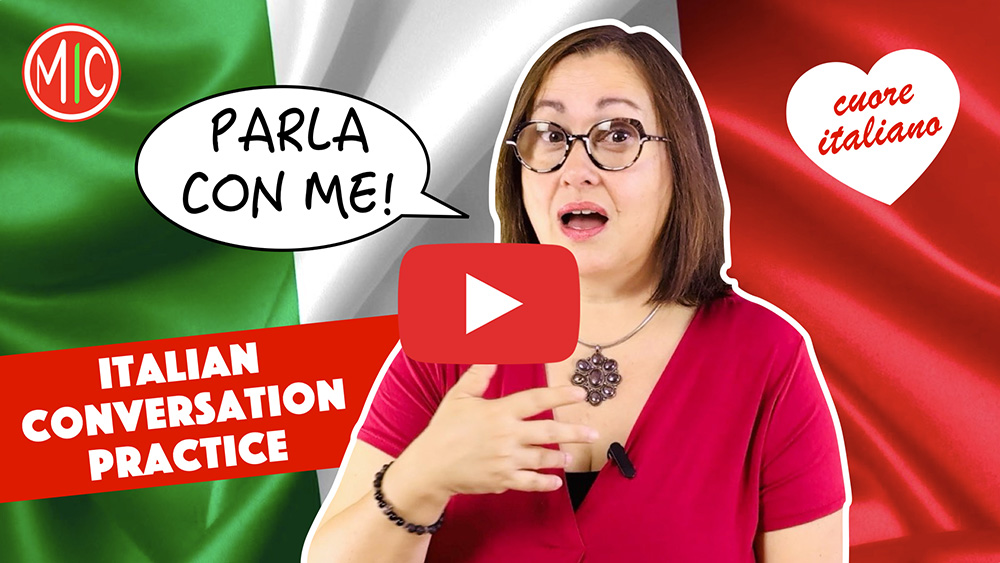
In our Ascolta e Parla videos, the goal is not to understand everything. The real goal is to train:
- your ear (orecchio);
- your pronunciation (pronuncia);
- your rhythm (ritmo);
- your confidence (sicurezza) when speaking.
Full understanding comes later; first comes the active use of the language, l’uso attivo della lingua, even with mistakes.
How to use audio and video content effectively
Watching a video passively is not enough: to study effectively, content must be reused. A productive approach includes:
- a first listen for general meaning (ascolto generale);
- a second listen and repeating aloud (ripetizione ad alta voce);
- an active recall phase: answering questions using the same words (recupero attivo);
- returning to the same content after a few days (ritornare dopo qualche giorno).
Parla con me!
This is the reason why in our videos I always encourage you to speak up, to respond, even with a yes or no or a few simple words. Passively watching a video is already something, but participating and being active gives us much more: it gives us confidence.
An active approach is a real game-changer. Sometimes I ask for an immediate, intuitive response; other times I prompt for an answer on content, or ask learners to answer questions using the vocabulary presented in the lesson. All of this is repeated several times; additionally, committed learners have the opportunity to practise even more with the special content we prepare for our patrons on Patreon.
Ama la tua voce italiana!
Responding aloud makes all the difference. This way, we train our mouth to form sounds, familiarise ourselves with the melody and rhythm of sentences, and practise pronunciation. The next time we want to say something in Italian in real life, it will be much easier, because we have already done it.
Consistency and repetition are essential. It is not wise to use study material only once, whether it is an article, an exercise, or a video. Watch a video over and over again until your answers come naturally. This way you will assimilate words, phrases, collocations, sounds; in short, you will develop a feel for the language.
Common mistakes when studying Italian
Many learners slow down or get stuck not because they lack ability, but because they fall into very common patterns: they keep looking up new ways to study Italian effectively and change methods too often, study only when motivation is high, avoid speaking for fear of making mistakes, and aim for perfection far too early. Making mistakes is not failure. Speaking imperfectly is simply part of the learning process.
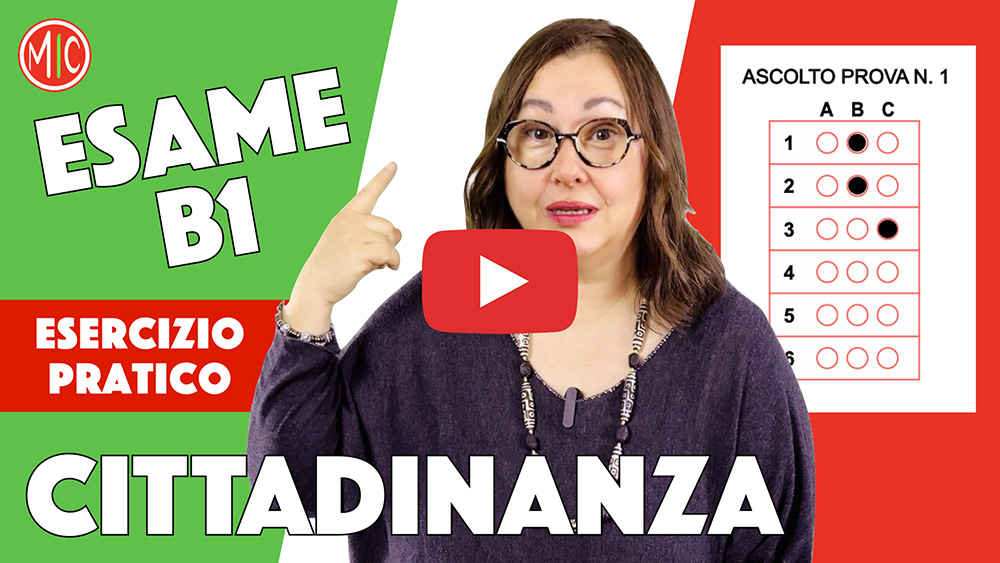
On our YouTube channel, we talk a great deal about the B1 citizenship certification: during the oral exam, perfection is NOT a requirement, but clear communication is. The simple principle of keeping the main objective clear, i.e. communication, helps us to get started and get into the right gear. So, should we lower our ultimate goal and not worry about improving and correcting our mistakes? Should we abandon the desire to speak correctly? Absolutely not. But the fear of making mistakes shouldn’t stop us from opening our mouths and speaking Italian. And this is a major obstacle for many learners.
Il tuo obiettivo per il 2026
In 2026, the goal is not to study an enormous amount of grammar or vocabulary, to finish every textbook, to understand everything immediately, or to speak perfect sentences from the start. The real goal is continuare: to keep listening, to keep speaking, and to keep returning to Italian. Because what you practise with costanza, over time, truly becomes yours. This year, learn Italian consistently!
In short: your 2026 routine should include regular and sustainable study, frequent listening, active use of the language, repeated exposure to the same material, and acceptance of imperfection. Create a path that you can realistically maintain over time.
Visit our main website to find all our video lessons and additional learning materials listed by topic and level, and get in touch if you need advice on your specific situation: I will be happy to help.
Buono studio!
Anna
Italian Lessons for Beginners
- Italian Speaking Practice – Parla italiano, vocabulary lessons, and pronunciation guides
- Italian Listening Practice for Beginners – Easy listening practice (listed from newest to oldest, begin with the oldest lessons)
- News in Italian for Beginners – Learn to understand the news in Italian (A2 and beyond)
Italian Textbooks
- A1 Italian Course for Beginners – From total beginner to elementary, with audio & exercises
- A2 Italian Pre-intermediate Course – From late beginner to pre-intermediate, with audio & exercises
- Italian Grammar: Concise & Clearly Explained – Italian grammar explained in English
- Italian for Duolingo Users – Essential grammar guide for Duolingo Italian course.
(Amazon affiliate links)